

In the News
What happened in healthcare recently—and what we think about it.
- Major healthcare fraud enforcement announced. The Justice Department Tuesday announced one of the largest coordinated healthcare fraud enforcement actions to date. The DOJ charged approximately 450 defendants across 41 states and territories involving more than $6.5 billion in alleged fraud. It included charges of telemedicine scams, Medicaid billing fraud, kickbacks and bribery, and illegal opioid distribution. The allegations include charges of fraudulent, medically unnecessary wound care and hospice care schemes involving bribery to enroll patients who were not terminally ill. The DOJ also announced agreements with Centers for Medicare & Medicaid Services (CMS), Department of Homeland Security, and the Federal Trade Commission to better identify and combat healthcare fraud.
- The Gist: Healthcare fraud and abuse enforcement activity is not new, but the scale and coordination of this enforcement action and other announcements reflects an aggressive posture from the federal government. The Justice Department isn’t messing around: this is a signal that the government views fraud, including healthcare fraud, as a major priority and way to safeguard taxpayer dollars. The investments in new tools and cross-agency collaboration to identify potential fraud indicate that this will be a long-term strategy, so we’d better get used to it. Hospitals and health systems may wish to adopt a better-safe-than-sorry approach and consider an internal audit of compliance systems internally and with external partners to get ahead of potential issues.
- Infant mortality fell to all-time low. S. infant mortality rates declined in 2025, according to preliminary estimates released this month by the Centers for Disease Control and Prevention (CDC). Infant deaths fell to just under 5.36 per 1,000 live births, which translates to hundreds of fewer infant deaths nationwide each year. Yet while the infant mortality rate has steadily declined over the past three decades, it remains nearly twice as high as rates in many other high-income countries, according to a study from Children’s Hospital of Philadelphia and University of California Irvine. Experts suggest the improvement may be due in part to expanded RSV prevention measures, including maternal vaccination and infant antibody treatments, as well as declines in sudden infant death syndrome associated with safe sleep education.
- The Gist: The data are welcome news, indicating we are on the right track. The cumulative efforts to improve maternal and infant health more broadly are working well. The encouraging decline follows several years of investments in maternal and infant health—from expanded postpartum Medicaid coverage and home visiting programs to broader doula coverage and updated clinical guidance. Increased focus on prevention and patient education appears to have paid off. Yet, infants still die in the United States at a higher rate than they do in other high-income countries. It will take a village to change that. For hospitals, this means continuing to collaborate with community partners to engage patients.
- Sugary drink, candy ban blocked. A federal judge Monday blocked a Department of Agriculture (USDA) attempt to allow states to use food stamps to buy sugary drinks, candies, and processed foods. The court ruled that the USDA could not let states redefine eligible Supplemental Nutrition Assistance Program (SNAP) foods through waivers, effectively blocking the agency from enforcing them. The ruling enables SNAP recipients to continue using benefits for these items at least temporarily. The decision to block the restrictions was administrative, not a judgment on nutrition policy itself. It is unclear whether the USDA will appeal the ruling.
- The Gist: The decision is reminiscent of the unsuccessful New York City large-quantity soda ban in 2014. It is noteworthy that the New York attempt, much derided at the time, may have been merely ahead of its time. Proponents of the Make America Healthy Again movement had considered banning the purchase of sugary drinks and candy using SNAP benefits to be a major achievement. The attempt aligns with the 2025-2030 Dietary Guidelines for Americans issued earlier this year and a CMS memo to hospitals about their nutritional services and obligations to patients. Care teams remain integral to educating patients on healthy consumer choices. Hospitals may also wish to align nutrition-related policies and food services for patients with the new guidelines and enable healthier choices with convenient healthier options.
Plus—what we’ve been reading.
- A genetic investigation of measles. Published this month in ProPublica, this investigation found it may be difficult for the United States to retain its measles-free status. To keep the designation, U.S. health officials must show the Pan American Health Organization that recent outbreaks are not a continuous chain of transmission. ProPublica found that the Texas and Utah outbreaks are genetically related. ProPublica reached the conclusion by analyzing more than 1,800 whole-genome measles sequences from public databases and building a viral family tree to trace mutations and evolutionary relationships. However, because data from Canada and Mexico are incomplete, it remains possible that the virus circulated elsewhere before returning to the United States. If that can be confirmed, the United States may still be able to keep its status. The CDC is conducting its own analysis.
- The Gist: This investigation suggests measles-free status for the United States may be off the table. It also demonstrates that the tools and methods to conduct serious epidemiological studies are now more broadly available. With more publicly available healthcare data than ever before, investigations like this show that healthcare organizations may be able to do the same. Hospital-based clinical informaticists and epidemiologists are well-positioned to leverage similar means and methods to build disease surveillance tools in-house. By combining public data and their own clinical data, hospital teams can generate real-time insights and bring them directly into patient care faster than ever, strengthening the public health infrastructure needed to mitigate future outbreaks.
Graphic of the Week
A key insight illustrated in infographic form.
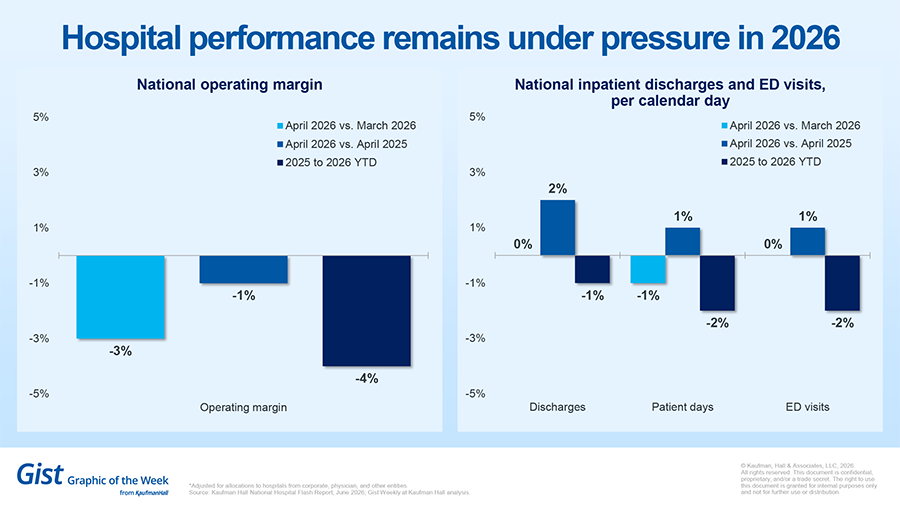
Hospital performance remains under pressure in 2026
Mixed performance on key volume indicators, staffing challenges, and expense growth continue to pressure hospital operations, according to Kaufman Hall’s latest National Hospital Flash Report. Discharges and emergency department visits declined year-over-year as patient days increased. The findings, which reflect hospital operational and financial performance through April, reinforce the need for leaders to explore focused prioritization and strategic planning for their organizations.
This Week at Kaufman Hall
What our experts are saying about key issues in healthcare.
Health system service lines have more data than ever, yet many leaders still struggle to translate performance metrics into meaningful action.
A new article explores how leading organizations are designing service line dashboards that reduce noise, focus on what matters most, and help drive growth, quality, access, and margin performance.
On Our Podcast
The Gist Healthcare Podcast—all the headlines in healthcare policy, business, and more, in 10 minutes or less every other weekday morning.
The Gist Healthcare Podcast is on hiatus until mid-July. The show will return with more conversations and more healthcare business and policy news then. In the meantime, you can subscribe on Apple, Spotify, Google, or wherever podcasts are available.
Thanks for reading! The Gist is on hiatus next week. We will return July 10. In the meantime, check out our Gist Weekly archive for past editions. We also have all our recent Graphics of the Week available here.
Best regards,
The Gist Weekly team at Kaufman Hall