

In the News
What happened in healthcare recently—and what we think about it.
- Growing concern over new Ebola outbreak. An Ebola outbreak is testing U.S. and international efforts this week, prompting the World Health Organization to declare a public health emergency. This is the third largest outbreak of Ebola ever, and some health experts believe cases are underreported. The rare strain, which has no vaccine or treatment, spread undetected for weeks, complicating contact tracing and treatment efforts. U.S. health officials activated a quick response to keep the disease out of the country, instituting travel restrictions for non-citizens and a health checkpoint in Washington, D.C., for returning Americans. To address concerns, the Centers for Disease Control and Prevention, some state health departments, and hospitals and health systems designated as Elite Special Pathogen Treatment Centers have scheduled training webinars for clinicians this and next week.
- The Gist: The bingo card is getting crowded. After the Covid-19 pandemic, disease outbreaks keep popping up, and putting healthcare providers, and the public, on the edge. Notably, these new outbreaks are not the familiar viruses of years past. They involve rarer strains and lesser-known virus families that leave providers navigating unfamiliar territory in real time. With Ebola at least, it is not our first rodeo. Many hospitals and health systems prepared plans over a decade ago when the last outbreak emerged. This means that the infrastructure is there, and the playbook is written. How hospitals and health systems meet the moment matters most as these and other viruses emerge.
- Sweeping changes to ACA exchanges in new CMS rule. The Centers for Medicare & Medicaid Services (CMS) in May finalized an overhaul of Affordable Care Act (ACA) exchange rules for 2027, tightening eligibility verification while giving insurers and states more flexibility in how marketplace plans are designed and regulated. The final rule reinstates pre-enrollment verification for many special enrollment applicants, adds income documentation requirements in some instances, and changes oversight of enhanced premium tax credit eligibility, which CMS said are intended to reduce improper enrollments and fraud. The agency also eliminated the requirement that insurers offer standardized plan designs and removed limits on the number of nonstandard plans carriers can sell on the federal exchange. In addition, CMS expanded eligibility for catastrophic plans and finalized a policy to allow insurers to offer plans that cover non-network provider organizations and facilities. CMS said the changes are intended to lower premiums, expand choice, and increase state flexibility. The changes arrive as exchange enrollment has already decreased, and several insurers have signaled pullbacks from ACA markets amid rising premium pressure and ongoing uncertainty.
- The Gist: The rule raises concerns about both coverage adequacy and reimbursement predictability. Broader use of catastrophic and non-network plans could increase patient cost exposure and leave hospitals dealing with more uncompensated care or difficult collections. The removal of standardized plan requirements may also make it harder for patients to understand benefits and compare products, potentially increasing enrollment volatility and administrative complexity. Insurers may use the additional flexibility to narrow benefits or alter cost-sharing structures as ACA markets continue adjusting to the expiration of enhanced premium tax credits. Also, keep an eye on the rule’s new non-network plan pathway closely, because those products would rely on fixed payment amounts rather than negotiated provider contracts. Hospitals may need to prepare for a more volatile exchange environment as insurers change products and patients face wider variation in coverage and increased responsibility in cost-sharing.
And—what we’re following.
- Rules around the Health Insurance Portability and Accountability Act could be updated as early as this month, likely requiring hospitals and health systems to strengthen and expand their cybersecurity efforts.
- A new Health and Human Services advisory committee, with the charge of advising the department on policy, met for the first time this month.
- Pediatric Medicaid enrollment is falling, according to new data.
Plus—what we’ve been reading.
- Medical records for sale. Published this month in The Washington Post, this investigation explores allegations that more than a dozen companies have sold patient records to law firms. According to the investigation, companies misrepresented themselves as healthcare provider organizations, accessing patient records through national health information exchanges and flipping them for profit. Patients in multiple health systems received notices that their information in their electronic health records was accessed, according to the investigation. The companies deny wrongdoing.
- The Gist: Patients’ data are being bought, sold, and transferred with little knowledge and recourse—all in the name of interoperability. Interoperability is the pot of gold at the end of the rainbow for virtually every stakeholder in healthcare—a single source record that can be accessed across care settings and health organizations, anywhere, anytime. Yet, this investigation sheds light on the vulnerabilities that accompany interoperability, and patients have a lot to lose. Few could have conceived the sale of patient data en masse for the benefit of elusive intermediaries. Without strict governance to ensure patient privacy, the path to interoperability might threaten patients’ trust in the process. Hospitals and health systems, as traditional advocates for their patients, have an opportunity to lead the charge in protecting patient privacy.
Graphic of the Week
A key insight illustrated in infographic form.
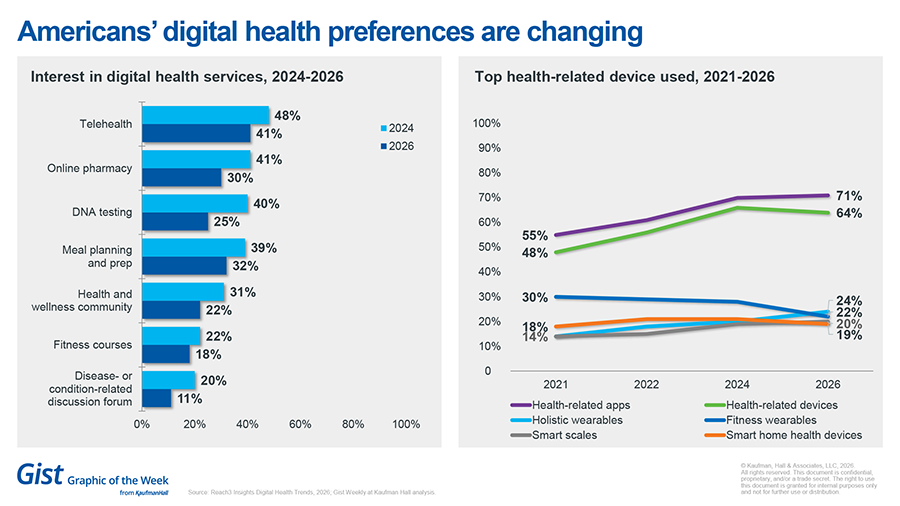
Americans' digital health preferences are changing
Use of health-related apps and devices has increased since 2021, even as consumers become more selective about the technologies they adopt, according to a report published this month. While nearly half of consumers track biometrics, sleep, or activity levels, usage patterns vary by age, and interest in many digital health services has declined post-pandemic. This signals shifting consumer expectations and preferences for digital health technology users increasingly want tools that help them track progress conveniently and accurately while fostering motivation, accountability, and a sense of control over their health, according to the report. Integrating patient-generated data from apps and devices into digitally connected care experiences may help health systems strengthen engagement beyond the hospital walls.
This Week at Kaufman Hall
What our experts are saying about key issues in healthcare.
Hospital leaders face a fundamental question in rating agency meetings: how do you communicate confidence and preparedness while acknowledging the very real pressures ahead? Lisa Goldstein explores the key messages healthcare leaders need to deliver to their rating agency counterparts in a new blog.
On Our Podcast
The Gist Healthcare Podcast—all the headlines in healthcare policy, business and more, in 10 minutes or less every other weekday morning.
The American Hospital Association and the West Health Institute are partnering on a project to help hospitals and health systems adopt and implement technology-enabled solutions at scale. Coming up this Monday, host J. Carlisle Larsen speaks with Chris DeRienzo, M.D., about the tech accelerator and the impact it could have on patient care.
To stay up to date, be sure to tune in every Monday, Wednesday, and Friday morning. Subscribe on Apple, Spotify, Google, or wherever podcasts are available.
Thanks for reading! We’ll see you next Friday with a new edition. In the meantime, check out our Gist Weekly archive for past editions. We also have all our recent Graphics of the Week available here.
Best regards,
The Gist Weekly team at Kaufman Hall