


For medically ready patients who need a lower acuity level of care before returning home, hospitals can be challenging places to fully heal and recover.
Patient vignetteShe no longer needed inpatient-level care, and yet there was nowhere else to go. A skilled nursing facility (SNF) could have provided the bridge, but every bed was full. So, she stayed in the hospital to recover, occupying an inpatient bed while patients requiring inpatient care in the overcrowded emergency department waited for one to become available. |
A growing bottleneck
The scenario above highlights a growing problem: hospitals across the country are facing difficulty placing patients into SNFs and other post-acute sites of care, delaying discharge of medically ready patients. Post-acute access constraints are structural and systemic and are reshaping hospital performance—including hospital margins, capacity, throughput, quality metrics, staff morale, and patient experience. Health systems that proactively redesign their post-acute strategy, particularly through aligned SNF and other post-acute partnerships, can materially improve performance across these dimensions and mitigate risk, while also equipping these facilities with the alignment and financial resources necessary to thrive.
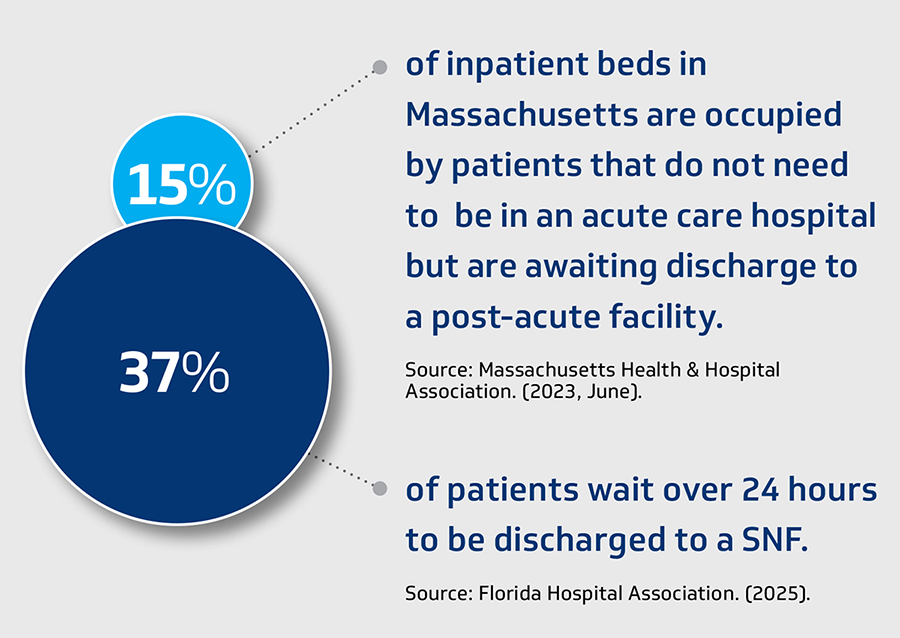
SNFs remain essential to post-acute care, playing a central role in hospital discharge flow, particularly for high-acuity patients, Medicare Advantage beneficiaries, and medically complex patients requiring nursing and therapy services. Timely access to beds has become one of the most persistent discharge bottlenecks hospitals face today. Demand for SNF beds continues to rise as the population continues to age, and older patients disproportionately require SNF-level post-acute care.
SNF bed supply fell 2.5% between 2019 and 2024, creating a sustained imbalance between supply and demand. As this imbalance persists, access challenges are likely to intensify rather than normalize. Hospitals in regions with SNF bed under capacity tend to experience greater mean length of stay, percentage of stays 28 days or more, and median distance traveled to admitting SNFs [1].
“Patients discharged to SNFs are expected to have an ALOS 70% higher than other sites of care, but observed ALOS exceeds that expectation, reaching 86%.”Source: Data from Vizient Clinical Data Base used by permission of Vizient, Inc. All rights reserved. Accessed May 2026. |
As SNF occupancy remains high, SNF operators exert greater leverage and selectivity in admissions—tightening discharge pathways and increasing scrutiny of referrals based on payer type, clinical acuity, and staffing alignment and workforce capacity. This growing selectivity is a key driver of avoidable hospital days, as more referrals are delayed or declined, leading to longer hospital stays for medically ready patients. Complex patients and those without clear payment sources become increasingly difficult to place and are left stuck in the hospital for prolonged periods.
These delays in SNF placement create real, measurable downside for hospitals, eroding hospital performance across multiple dimensions. Each excess inpatient day carries real variable cost. The impact on lost inpatient capacity, especially with higher-acuity or elective cases, is magnified in hospitals with strong demand and high-cost structures, including AMCs and regional referral hubs, where patients are turned away. Impacted hospitals experience increased inpatient congestion, ED boarding and diversion, and reduced staffing efficiency leading to poor morale and burnout, lower patient satisfaction, and greater risk for hospital-acquired conditions. For those health systems referenced above with high demand and a higher fixed cost structure, the financial ramifications are even more severe considering the lost volumes that would otherwise exist if patients were discharged to SNFs more expeditiously.
Solving the length of stay problem: a nuanced approach
Solving the problem isn’t necessarily about owning or acquiring SNF beds. Hospital-owned SNFs often also face the same constraints as third-party operators, including staffing shortages, payer mix pressure, regulatory and compliance requirements, and capacity limits driven by acuity and workforce. In most instances, hospital-owned SNFs, too, generate negative operating margins and experience occupancy and capacity challenges, as ownership alone does not eliminate delayed placements, admission selectivity, and extended hospital LOS for medically ready patients. These realities reflect the broader structure of SNFs as low-margin, operationally complex facilities that require deep operating expertise, specialized staffing models, scale, and sustained focus.
For these reasons, ownership decisions and access strategies are related but distinct and should be evaluated separately as part of a holistic post-acute partnership portfolio.
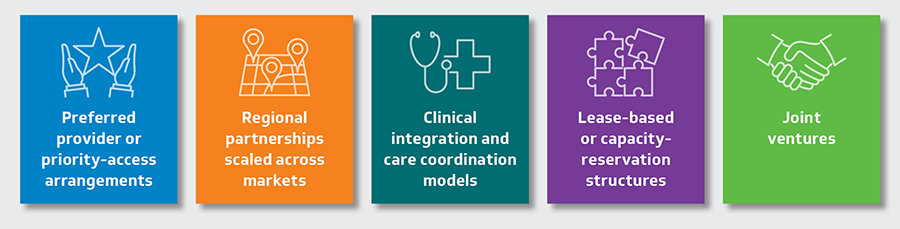
Health systems are better positioned to optimize SNF access through aligned partnerships with experienced third-party operators, leveraging a holistic and intertwined set of contractual, clinical, and operational mechanisms that prioritize access, throughput and quality.
In some cases, hospital-owned SNF assets can be strategically incorporated into these partnership models by combining owned capacity with external operating expertise to enhance access reliability, improve operational and financial performance, reduce hospital administrative burden, and increase the attractiveness of partnerships for SNF operators.
Ultimately, improved SNF access is driven by alignment, incentives, and operating expertise—not ownership alone.
Case Study – Bed Leasing PartnershipImage
One academic medical center partnered with multiple SNF operators on a bed lease arrangement that was expected to achieve a +250% ROI, with bed lease cost only 10% of inpatient stay cost, reducing delays and freeing capacity.
The situation: A high inpatient length of stay (LOS) due to delays in discharging medically ready SNF-eligible patients left an academic medical center (AMC) strained operationally and financially. SNF access constraints resulted in a $15M+lost contribution margin annually, tying up beds, driving higher costs, and limiting patient throughput.
Solving the LOS problem: The AMC assessed the root cause of current challenges, identifying the excess costs and patient cohorts driving delays. The organization then explored multiple post-acute care partnership models (acquisition, joint venture, bed lease) and determined that a bed lease model offered the highest upside with lowest cost and operational risk. It identified current and prospective SNF partners and ultimately negotiated partnerships with two SNF operators on a scalable bed lease arrangement.
The outcome: Through the partnership, the AMC established “go-to” discharge locations for hard-to-place patients (clinically complex, no-payer) and built-in scalability allowing for expansion of leased beds overtime. Not only did this create the “go-to” discharge location, but it is anticipated to reduce administrative burden associated with single case agreements and the need to reach out to several different SNFs to determine whether a patient was eligible for discharge to the SNF. The arrangement began with a modest number of beds, with option to scale in future years. The bed lease cost only 10% of the inpatient stay cost, ultimately reducing delays and freeing inpatient bed capacity. |
Several health systems, such as Stanford Health Care, Scripps Health, and UC Davis Health, have also had success with the bed reservation / bed lease program as an aligned alternative for post-acute care access and patient throughput [2].
Proactive, strategic investment
In our observations, systems that invest in aligned post-acute partnerships ultimately experience better discharge performance. Aligned partnership—not ownership alone—is the strongest predictor of improved SNF access and throughput. The most effective strategies are market-specific, patient-mix driven, and mutually beneficial for hospitals and SNF operators.
Oftentimes, a coordinated request for proposal (RFP) process to organize a system’s skilled nursing network can help identify and enable mutually beneficial partnership approaches in a streamlined and efficient manner.
Partnership approaches: The right partnership must be a win-win with hospitals gaining predictable access and throughput and SNF operators gaining volume, stability, and alignment.
A call to action for health system leaders
Length of stay challenges are solvable—but only with deliberate, system-level strategy. Systems that wait for market conditions to improve may face growing pressure to solve the LOS problem for medically ready patients. Systems that proactively assess and redesign their post-acute strategy can reduce LOS, improve margins, and protect quality and patient experience.
Key questions to begin identifying the right partnership approach• Which patient cohorts are driving the largest discharge delays? • How many SNF beds are truly needed to relieve pressure? How many LTC and how many short-term rehab? • Which post-acute operators operate locally, and how do they perform? • Where do incentives misalign today? • Where are SNF and other post-acute delays costing us the most? • How predictable is our SNF and post-acute care access today? • Are we structured for the next 5–10 years of demand? |
1: McGarry, B. E., Wilcock, A. D., Gandhi, A. D., Grabowski, D. C., Geng, F., & Barnett, M. L. (2026). Changes in US Skilled Nursing Facility Capacity Following the COVID-19 Pandemic. JAMA internal medicine, 186(3), 285–292. https://doi.org/10.1001/jamainternmed.2025.7197
2: Source: Taylor, M. (2025, April 11). A discharge strategy 3 systems use to save millions. Becker’s Hospital Review. https://www.beckershospitalreview.com/patient-flow/a-discharge-strategy-3-systems-use-to-save-millions.html