


Partnerships, like all relationships, are de facto collaborative. Certain success factors are well known, including the importance of cultural alignment, constant communication and effective post-closing integration. Based on our collective experience assisting health systems with the negotiation of strategic partnerships, we share other lessons learned that are important considerations. These are tangible steps that require intentional focus and may require hard choices during the partnership development process but are important for ensuring long-term success. We hope these “inside baseball” lessons and case studies are useful for organizations when negotiating their next strategic partnership.
Lesson 1:Develop a credible business case early in the partnership process
The development of a credible business case early in the partnership process before definitive agreements are executed greatly improves the likelihood of success. This enables partners to articulate and quantify value creation and avoids time and expense spent pursuing deals that do not enhance mutual value. A thoughtful business case can serve as the foundation for an effective communication strategy that clearly articulates the benefits of the partnership to key stakeholders, both internal and external. Given the high level of scrutiny placed on healthcare partnerships, it is critical to demonstrate tangible benefits to patients and the community.
Key benefits of a well-developed business case |
| The partnership business case |
| 1. Generates buy-in and enthusiasm for partnership |
| 2. Improves board confidence |
| 3. Helps the parties negotiate contentious deal points (i.e., partnership governance, new management structure, etc.) |
| 4. Serves as blueprint for integration plans and contains: |
• Synergy and dis-synergy estimates • Costs of integration and capital requirements incorporated into a set of combined projections along with implementation tactics • Reasonable expectations and clear identification of resource requirements, contingencies and key areas of risk • Operational and clinical leadership involvement to improve feasibility of the plan |
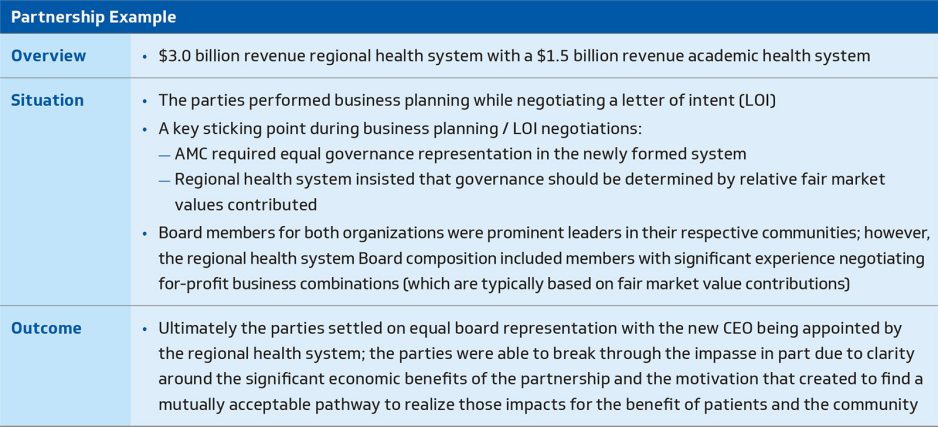
For two health systems coming together, early business planning demonstrated the potential for significant value creation as highlighted in the case example below. Had the parties not proven the value of the partnership prior to negotiating the letter of intent, the partnership would have likely failed. Negotiating governance terms in any large-scale partnership is complex. A credible business plan that shows significant value creation helps prevent gridlock and enables partnerships to go forward.
Figure 1. Early business planning case example
Lesson 2: Safeguard against misaligned incentives in definitive agreements
At the onset of a joint venture and other less than fully integrated relationships, parties may overlook potential alignment concerns (and not incorporate appropriate safeguards into definitive agreements) due to a reliance on pre-existing relationships or strong desire to complete the deal. Without safeguards, however, entering joint ventures and other less than fully integrated relationships where the parties have misaligned incentives strains the relationship and will may potentially cause the partnership to fail.
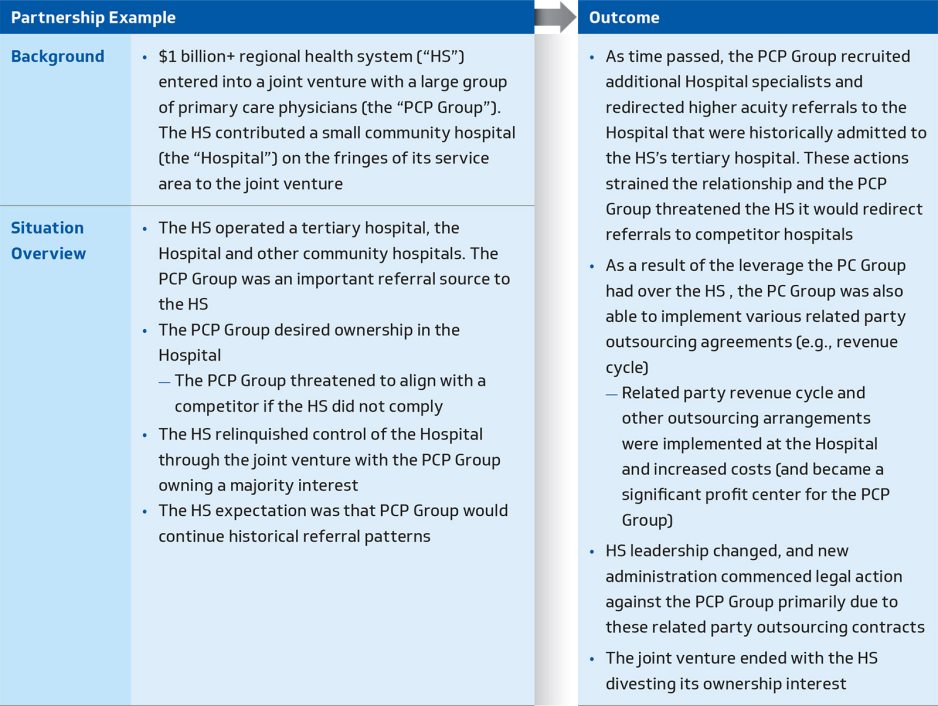
A case example that illustrates this concept is provided below. The joint venture failed and resulted in dissolution, because partnership interests were fundamentally misaligned.
Figure 2. Competition and misalignment case example
Lesson 3:Create durable partnership structures that support integration
The greater the ability to terminate or unwind a partnership, the less integration may be achieved. Unwind provisions tied to time or financial metrics often create uncertainty and discourage investments in operational integration, limiting the synergies available through partnership. In less than fully integrated partnerships, it is customary and appropriate to include reasonable unwind provisions. However, in practice easy unwind often correlates with a lack of commitment to the partnership, making it challenging to optimize the relationship to achieve its full potential.
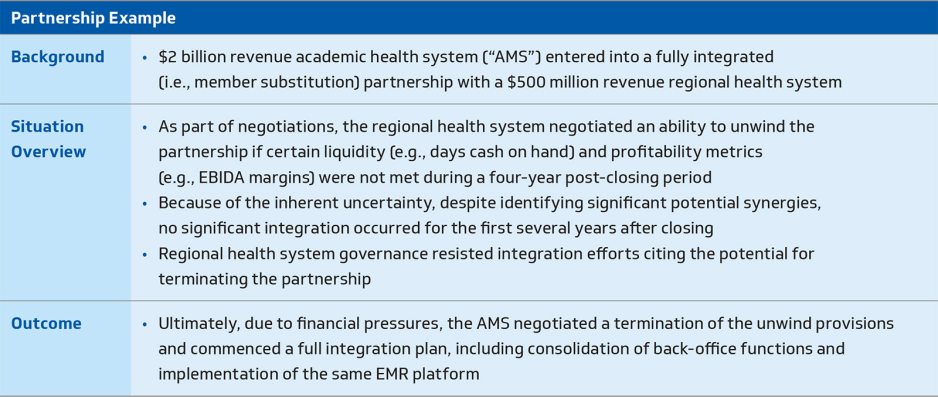
The case example below illustrates how unwind provisions resulted in unintended consequences leading to an us versus them mentality that ultimately inhibited meaningful integration.
Figure 3. Durable structures case example
Lesson 4: Enter into partnerships with eyes wide open
Relying on past success stories, reputation or leadership representations without investing the time to independently validate expected capabilities that are a significant component of the partnership’s value proposition can backfire. While health systems typically conduct adequate confirmatory due diligence reviews such as quality of earnings, coding and legal reviews to assess risk and provide a historical perspective, promises of exported capabilities (such as value-based analytics) and other factors that are the basis of the partnership’s true potential aren’t always vetted sufficiently by the organization relinquishing control. Confirming the benefits objectively can avoid unintended consequences and surprises.
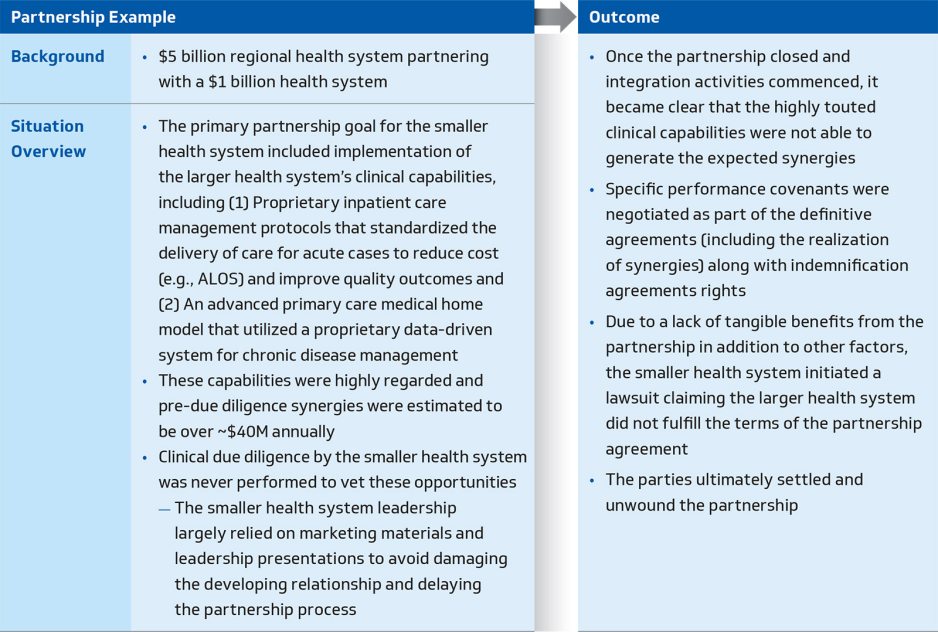
The case example below highlights the outcome of a health system that relied on collateral materials and leadership representations regarding the effectiveness of key capabilities. These key capabilities were the primary deal currency used to convince the organization to cede control and enter a fully integrated partnership (i.e., change of corporate member transaction) with the larger health system. Execution matters; the failure to realize expected benefits ultimately caused the partnership to rupture.
Figure 4. Thorough due diligence case example
Lesson 5: Be thoughtful about highly structured partnerships, which often fail
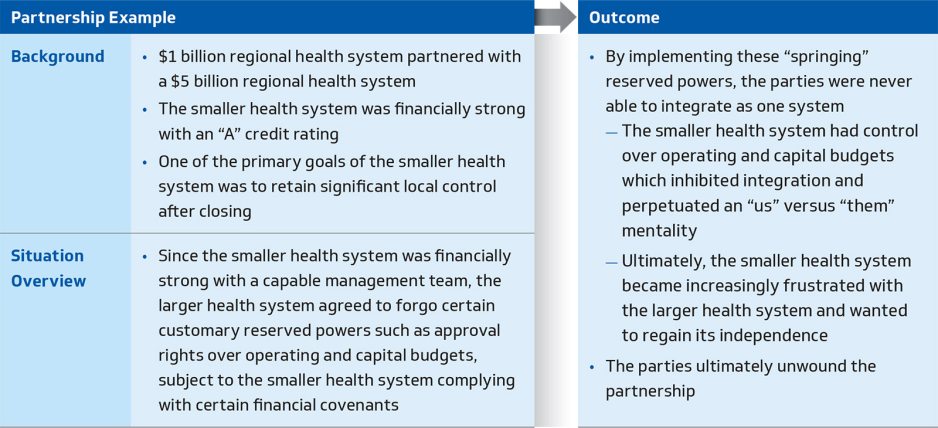
The highly regulated nature of the healthcare industry sometimes necessitates complex partnership structures to achieve shared objectives. To reach mutual agreement on difficult issues, parties may seek to implement highly structured features into definitive agreements such as “springing” governance powers based on financial performance. There are some cases where complexity is appropriate, as often is the case with physician relationships and value-based care joint ventures, for example. However, a degree of complexity beyond what is necessary to effectuate a given model can be counterproductive. Definitive agreements that are over-engineered to find a workaround for gating issues often lead to failure and should be avoided. Instead, enhancing other areas of partnership consideration (e.g. capital commitments) and striving to reach agreement with simpler agreements that directly address the issue(s) in question should be the preferred path forward.
The below example illustrates how highly structured governance terms ultimately led to dissolution of the partnership. A traditional merger structure was burdened by complex governance-related provisions to break through a negotiation hurdle. While this allowed the parties to reach agreement in the short term, the long term the success of the relationship was compromised.
Figure 5. Highly structured partnerships case example
Conclusion
Partnerships don’t fail because of bad intent; they often fail because of avoidable missteps early in the partnership process, often in moments of optimism and goodwill. These observations aren’t necessarily new or novel, but they highlight important steps that can be taken during the partnership process requiring time, resources, hard choices, and purposeful intention and confer real impact on the success of the partnership. As senior leaders evaluate future partnership opportunities, heeding these lessons will be invaluable for building successful partnerships that endure.