


Workforce instability is now an executive issue, with nurse manager support directly tied to reducing turnover and burnout while improving care quality and the bottom line.
The most significant constraint on healthcare performance today is not capital, technology or demand—it is workforce stability. What was once viewed as a workforce management issue has become a core enterprise risk, directly affecting quality, safety, access and margin. Persistent turnover, vacancies, burnout and leadership instability are no longer episodic challenges.
They are persistent signals that demand executive-level strategy and accountability.
These pressures cascade through the organization but are most acutely absorbed by the nursing workforce—the backbone of care delivery and patient experience. From enterprise strategy to bedside execution, the health system’s ability to perform, transform and grow increasingly depends on its ability to stabilize and sustain this workforce.
Within this imperative, the nurse manager role represents a critical inflection point. Nurse managers sit at the intersection of strategy and execution, responsible for translating organizational priorities into daily operations while maintaining staff engagement, quality and safety. Yet as complexity has increased, the role itself has expanded without corresponding alignment of authority, resources or clear role design. As a result, the burden of execution and culture most often lands with nurse managers, even as the conditions needed for their success remain misaligned.
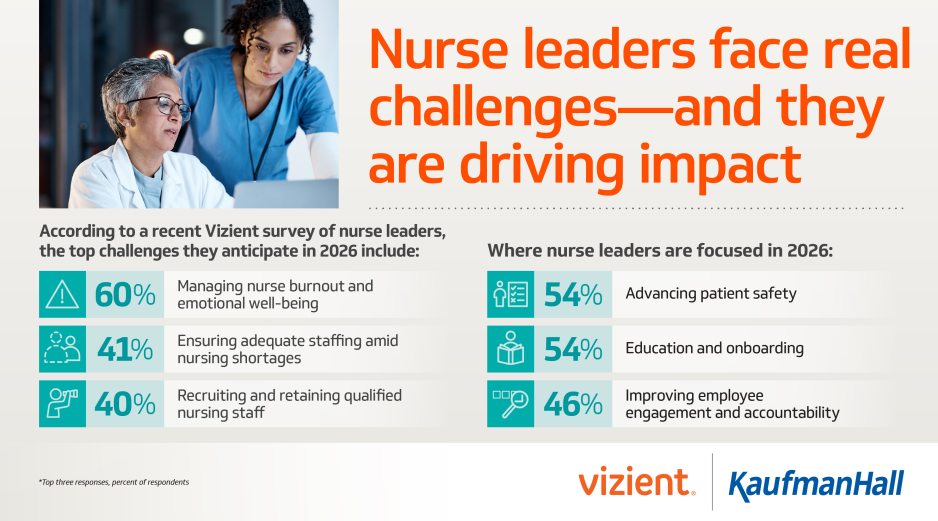
A recent Vizient survey of nurse leaders underscores the pressure facing nursing leadership today. The top challenges shaping priorities in 2026 include managing nurse burnout and emotional well-being (61%), ensuring adequate staffing amid shortages (41%) and recruiting and retaining qualified nurses (40%). These are not isolated operational concerns. They reflect a broader misalignment between influence, accountability and role sustainability that places the nursing workforce—and those who lead it—at increasing risk.
Short-term labor solutions may blunt immediate disruption, but they do not address the structural drivers of instability. To protect performance and position for growth, health systems must elevate workforce stability to a strategic priority grounded in evidence and informed by the lived experience of nursing leaders and frontline teams.
Nurse managers: essential and under strain
Research consistently shows that nurse managers have a direct and meaningful impact on staff retention and engagement, patient experience and clinical outcomes. At the same time, the role itself has become increasingly unsustainable.
Recent workforce data from the American Organization for Nursing Leadership and Laudio Insights illustrate the strain. Twelve percent of nurse managers report intent to leave their roles, with 9.5% exiting, while turnover remains elevated at 7.5%. At the same time spans of control continue to widen. Twenty-five percent of inpatient nurse managers now oversee dozens—and in some cases more than 75—direct reports.
High spans of accountability, particularly in the highest quartile, are associated with higher staff turnover and increased corrective action, limiting a manager’s ability to coach, develop and proactively support teams.
This creates a paradox at the center of the workforce challenge. The role with the greatest influence on workforce stability is itself at elevated risk. When nurse managers are stretched beyond capacity, the consequences cascade—accelerating RN turnover, eroding unit culture and undermining quality and safety.
The workforce imperative: strategic risk and opportunity
The nursing workforce is no longer just an operational concern. It is a strategic enterprise issue with direct implication for financial performance, quality outcomes and growth capacity.
Key workforce indicators, according to NSI Nursing Solutions, Inc., reinforce the magnitude of the challenge: sustained RN turnover at 16.4%, vacancy rates at 9.6%, first-year nurse retention at 87.2% and $4.75 million in annual turnover-related losses for the average acute care hospital.
These pressures flow directly to the bottom line through premium labor utilization, lost productivity, reduced throughput and preventable quality events. At the same time, the opportunity is clear: Organizations that invest in workforce stability consistently demonstrate stronger performance—lower mortality, reduced length of stay and readmissions, fewer adverse events, improved patient experience and reduced labor volatility.
Workforce stability is not a soft metric. It is a financial, quality and growth strategy.
The path forward: keep, build and optimize
High-performing health systems approach workforce strategy through three mutually reinforcing actions: keeping the workforce they have, building the workforce they need and optimizing the workforce they want. These actions must be pursued together to generate durable results.
1. Keep the workforce you have
Retention delivers the highest return on workforce investment. Stable nursing teams are associated with stronger performance across quality, safety, experience and financial metrics. Stable, engaged nursing teams are associated with fewer harms, less rework, lower agency utilization and stronger financial performance. Nurse managers are the linchpin of this effort.
When spans of control are manageable, administrative burden is reduced and well-being is prioritized, organizations see meaningful improved RN retention and engagement. Early leadership tenure represents a critical window of opportunity. Nurse managers are most likely to exit management—or the organization entirely—within the first four years, driven by role clarity, workload and compensation misalignment. Supporting nurse managers early and intentionally is essential to protecting the workforce already in place.
Organizational culture further determines whether retention efforts succeed. Healthy work environments characterized by psychological safety, trust, accountability and strong leadership are associated with lower burnout, improved retention and better patient outcomes. Adoption of high reliability organization principles reinforces these conditions by creating systems that anticipate risk, support frontline decision-making and strengthen shared accountability for quality and safety.
2. Build the workforce you need
Sustaining the nursing workforce requires deliberate investment in preparation, education and transition. Programs such as Vizient/AACN Nurse Residency Program™ support newly licensed nurses and improve first-year retention.
Equally important is developing emerging nurse managers with the skills required to lead in today’s environment: financial acumen, human capital management, quality improvement and change leadership. These skills cannot be assumed or learned by attrition. Programs such as Vizient Transition to Nurse Leader Program strengthen succession planning. Without intentional development, health systems expose themselves to leadership gaps that amplify turnover and destabilize care delivery.
3. Optimize the workforce you want
Persistent dissatisfaction and frustration with staffing and scheduling reflects the limits of traditional workforce models. Nurse leaders are routinely asked to balance role overload, complex patient needs and financial constraints using tools that fail to reflect real demand variability.
As analytic capabilities mature, more precise approaches to predicting workload and planning staffing have emerged. Reliance on averages, such as midnight census, introduces chronic over- or understaffing and can obscure true demand patterns. In contrast, advanced and predictive analytics allow organizations to anticipate variability and align resources more accurately with need.
Other industries, from retail to manufacturing, have long used data-driven productivity models to solve complex demand and staffing challenges. While still emerging in healthcare, similar approaches offer the potential to redesign care delivery, improve throughput, reduce staffing costs and strengthen clinician and patient satisfaction.
Optimization modeling enables leaders to evaluate millions of possible staffing configurations while accounting for real-world constraints such as demand, staffing models and work rules. Organizations applying these approaches report improved alignment of staffing to demand, reduced labor costs and higher satisfaction with scheduling processes.
Optimization also requires redesigning leadership and care delivery models to better align work with skills. This includes reducing cognitive and administrative burden, leveraging team-based leadership structures and using technology—including virtual care delivery and agentic AI—to shift nonclinical tasks away from frontline leaders.
Just as importantly, optimization demands listening. Survey insights from nurse managers and CNOs consistently point to practical, high-impact priorities such as manager-centric platforms, administrative support roles, clearer role design including assistant nurse manager models, flexible scheduling and workplace safety supports. These are actionable changes informed directly by those closest to the work.
A call to executive action
Healthcare transformation will not succeed without a stable, engaged nursing workforce. Workforce stability, in turn, cannot be achieved without sustained investment in the nurse manager role.
For healthcare executives, this moment represents both responsibility and opportunity. By keeping the workforce they have, building the workforce they need and optimizing the workforce they want, health systems can strengthen culture, improve outcomes and protect margin. Organizations that treat workforce strategy as a competitive differentiator rather than a reactive expense will be best positioned to deliver high-quality care in an increasingly constrained environment.
More resources
Explore results from a Vizient and Laudio Insights survey about the importance of the nurse manager role in driving workforce stability and patient outcomes.
Read this article about rethinking the healthcare workforce in the wake of the One Big Beautiful Bill.
Listen to this HealthLeaders podcast episode where, Evy Olson, vice president of nursing programs at Vizient, discusses why the transition from nursing school to professional practice is so difficult for early-career nurses and where many organizations fall short in preparing nurse leaders for today’s operational, emotional and strategic demands.
Supporting nurses and nurse leaders
New nurses: The Vizient/AACN Nurse Residency Program (NRP)—one of the first of its kind—helps transition newly licensed nurses from academic to practice. Developed by Vizient and the American Association of Colleges of Nursing, the NRP includes an evidence-based curriculum and interactive exercises. The NRP is designed to help decrease the nurse turnover rate, improve decision-making skills, enhance clinical nursing leadership practices and promote the incorporation of research-based evidence into practice. Participants benefit from access to benchmarking data, an up-to-date curriculum and the opportunity to network with peers.
Nurse leaders: The Vizient Transition to Nurse Leader Program strengthens leadership skills and boosts nurse leader engagement, performance and retention. From strategic decision-making to staff wellbeing, the program helps create high-performing, resilient nursing teams across the continuum of care.
Member Networks: Vizient Member Networks—with 10 C-level networks including chief nurse executives—drives healthcare performance improvement to help hospital and healthcare leadership teams accelerate their high-performance journeys.