

In the News
What happened in healthcare recently—and what we think about it.
- UnitedHealthcare reduces prior auths. UnitedHealthcare announced last Tuesday that it would reduce prior authorizations by 30% for a range of medical services. Currently, only 2% of its covered services require prior authorization, about 92% of which are approved, typically within 24 hours. The move to eliminate prior authorizations for some outpatient services, therapies, and diagnostics comes as UnitedHealthcare continues its effort to build on a series of industry-wide commitments to improve prior authorization standards. UnitedHealthcare also said that more than 70% of its prior authorization requests will move to a standardized submission system by the end of the year.
- The Gist: Prior authorizations are a major source of tension between payers, providers, and patients. Delays and denials reduce access to timely care for patients and create administrative, financial, and operational complexity for physicians and health systems. Payers have also been feeling pressure to standardize and create efficiency for their members. The impact of steps by UnitedHealthcare and other payers to reduce prior authorizations and standardize procedures is still to be determined. However, laying the groundwork for greater automation, efficiency, and interoperability that enables more strategic collaboration across the industry is an important first step.
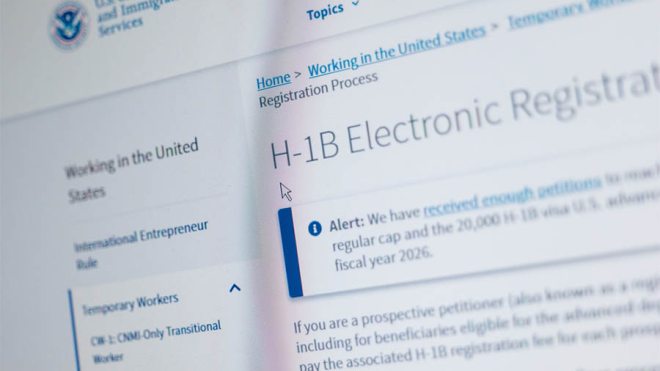
- Visa processing update for foreign-born physicians. Visa applications associated with medical physicians will continue processing, according to a U.S. Citizenship and Immigration Services website update last week. Earlier this year, the Gist reported that the Trump administration expanded immigration screening rules affecting foreign physicians with an update that intensified vetting of foreign nationals seeking visas and immigration benefits. Visa processing for foreign physicians slowed, leaving some physicians unable to work despite approved roles in U.S. hospitals. The latest update serves to improve lift holds and continue visa processing for physicians, who remain integral to ensuring access to patient care amid a growing physician shortage.
- The Gist: The new direction in visa application review aligns with workforce realities in healthcare and the health needs of Americans, especially in rural and underserved areas facing exceptional physician shortages. Foreign-born physicians account for roughly a quarter of the medical physician workforce. For hospitals and health systems, foreign-born physicians, and the patients they serve, this policy update is good news: the likelihood of canceled clinics, longer wait times, and reduced access may be significantly diminished.
- AI physician impersonation lawsuit. The state of Pennsylvania recently filed a lawsuit against Character.AI, alleging that its AI chatbot “companions” illegally posed as a licensed medical professional and provided medical advice. According to the state, one chatbot falsely claimed to be a licensed psychiatrist in Pennsylvania and provided a fictitious license number, which the lawsuit alleges violates Pennsylvania’s Medical Practice Act prohibiting individuals and entities from presenting themselves as licensed healthcare professionals without proper credentials. The lawsuit aims to stop AI bots from impersonating licensed clinicians, providing medical and mental health advice, and misleading users about qualifications.
- The Gist: The lawsuit represents the first enforcement action of its kind and could become precedent-setting in how regulators approach generative AI in healthcare. The move comes as part of a broader effort by Pennsylvania Gov. Josh Shapiro’s administration and other AI leaders and organizations to create guardrails around AI technologies. The lawsuit reflects growing regulatory scrutiny over how generative AI systems are used in healthcare and whether AI companies can be held accountable when bots simulate licensed professionals or provide quasi-clinical guidance without oversight. The distinction between an AI role-playing as a physician and an actual physician providing medical advice is not simply just semantics—it is fundamentally about human identity, licensure, accountability, and the inherent trust patients place in clinical expertise.
Plus—what we’ve been reading.
- The medical breakthrough of the decade. Published earlier this month in The New York Times, this article describes how doctors saved the life of an infant with a rare genetic disease with CRISPR and mRNA technology. By correcting a single DNA error, the clinical team corrected a gene mutation responsible for a life-threatening genetic condition that compromised his liver and brain. In lieu of a liver transplant, a single dose of gene therapy at six months helped the child thrive within a year. Physicians compressed years of treatment development across several institutions and obtained FDA authorization to administer the experimental therapy within months.
- The Gist: CRISPR technology has profoundly changed medicine as a tool for customizable, precise, individually adaptable “molecular surgery.” As a gene therapy, its impact is obvious and game changing. Yet the effort to implement it to meet current demands does not scale. The healthcare system has simply not caught up. Current models for drug development of mass market drugs and regulatory frameworks are serious hurdles that must be overcome. For hospitals and academic institutions leading the charge in cell and gene therapies, paving the path for more robust adoption of 21st century biotechnology means enabling institutional collaboration and supporting efforts to shorten its bench to bedside journey.
Graphic of the Week
A key insight illustrated in infographic form.
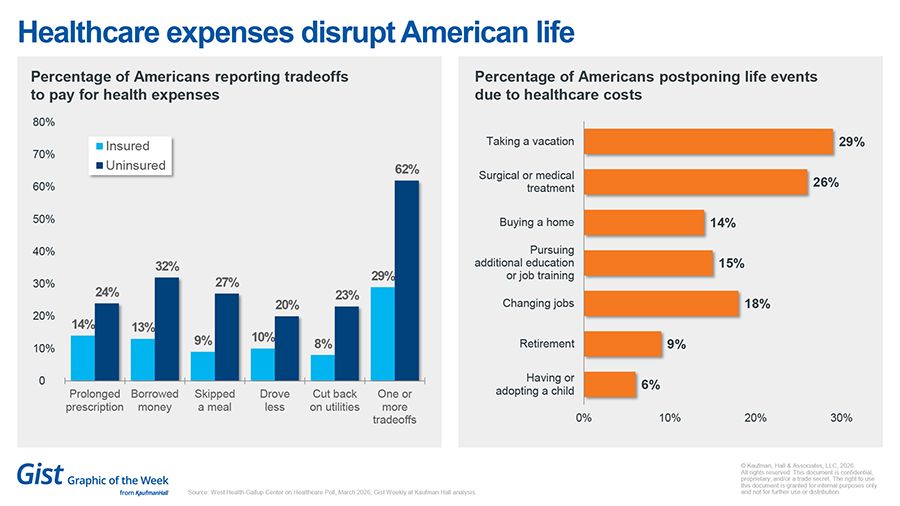
Healthcare expenses disrupt American life
Americans are increasingly making serious trade-offs that impact their health and daily lives to afford health expenses, according to a recent report from West Health-Gallup Center on Healthcare in America. About 30% of insured and 62% of uninsured Americans—across income brackets—have made at least one or more difficult trade-off: prolonging their prescription, skipping a meal, cutting back on utilities or borrowing money. A third reported postponing vacations and surgical and medical treatment alike. These trade-offs are not “nice to have.” Not taking medication as prescribed, skipping meals, cutting back on utilities especially during extreme weather, and delaying surgical and medical treatment carry serious medical risk for harm that leads to increased ED visits, readmissions, and other avoidable costly care that may impact hospitals and health systems.
This Week at Kaufman Hall
What our experts are saying about key issues in healthcare.
Synergies and economies of scale, once a primary driver of merger activity, are no longer sufficient to justify the cost.
A new article explores the broader, more complex objectives of today’s transactions, and the emergence of integration as a strategic discipline—one that must actively preserve, capture, transform, and sustain value over time.
On Our Podcast
The Gist Healthcare Podcast—all the headlines in healthcare policy, business and more, in 10 minutes or less every other weekday morning.
Earlier this week, we heard the conclusion of JC's three-part conversation with Robert Wachter, MD, Chair of the Department of Medicine at the University of California, San Francisco and author of A Giant Leap. The series explored what happens as AI tools move from early excitement into wider real-world use, and what that could mean for clinicians, patients, and the future of healthcare.
Coming up this Monday, a new study finds that walking can have a huge impact on readmissions for post-surgical patients. We'll get that story and other business and policy news next week.
To stay up to date, be sure to tune in every Monday, Wednesday, and Friday morning. Subscribe on Apple, Spotify, Google, or wherever podcasts are available.
Thanks for reading! We’ll see you next Friday with a new edition. In the meantime, check out our Gist Weekly archive for past editions. We also have all our recent Graphics of the Week available here.
Best regards,
The Gist Weekly team at Kaufman Hall