

When was the last time you looked at your slots?
Graduate medical education (GME) is one of academic medicine’s largest investments and one of healthcare’s most important workforce levers. At a time when health systems face uneven specialty distribution and growing access challenges, health systems must look beyond the number of medical school graduates entering the pipeline and consider how GME shapes specialty distribution and long-term access to care.
Medical school determines who enters medicine. But GME has a far greater influence on what kind of physicians they become, including where they practice. Residency structure, specialty mix, and training environment all shape workforce distribution in ways that directly affect access and long-term physician supply.
Most AMCs today operate well beyond their Medicare-funded caps, often by a wide margin. The Medicare GME cap is the federally established limit on the number of residency positions Medicare will support financially at a teaching hospital, based for many hospitals on the hospital’s resident count in 1996. Positions above that cap typically receive little or no additional Medicare funding, requiring hospitals to subsidize the cost themselves.
Data from Vizient’s 2025 Funds Flow Benchmarking Study* found that the median AMC operates at roughly 1.5 times its Medicare cap. This is not new and not inherently problematic. Unfortunately, newly resurgent financial pressures are forcing academic medicine to reexamine long-standing assumptions about how resources flow across the enterprise, and GME must be a crucial aspect of that conversation. It is mission-critical, but it is also expensive.
Many AMCs have little understanding of whether their over-cap residency and fellowship positions reflect current strategic reality. In most organizations, residency slots accumulate over time, the byproduct of a series of independent requests and short-term reactions rather than a single decision borne out of strategy. Typically, a department identifies a shortage and makes a case for expansion; leadership agrees, and additional slots are added. A few years later, another request emerges in a different specialty, and the process repeats.
Once it happens, it’s baked in. Slots are almost never scaled back, even when circumstances change. Each individual decision may have been justified, but taken together, they can create a training footprint that likely is misaligned with current workforce or clinical needs.
The underlying issue is the absence of a regular, structured review. GME is usually treated as a fixed asset when it should be managed as a dynamic portfolio.
Part of the challenge is that GME planning is often separated from broader enterprise strategy. The two should be tightly integrated. Decisions about residency and fellowship positions directly influence service line growth, physician recruitment and succession planning, ambulatory care expansion, and research. Organizations that treat GME as a parallel academic function rather than a core strategic input risk creating misalignment between the physician workforce they train and the system they are trying to maintain.
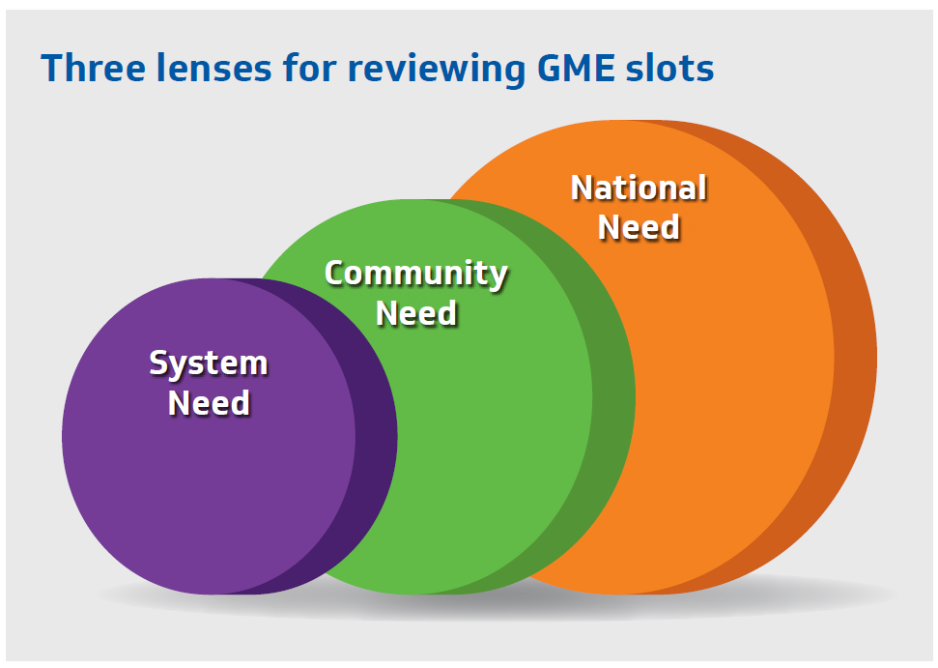
Three lenses for a strategic review
Smart AMCs are exploring ways to intentionally redesign their residency models. To start with, they need a practical way to evaluate their current state. Three lenses provide a useful entry.
- National need. Healthcare delivery is evolving faster than many training models. Residents today expect exposure to care environments and practice models that reflect modern medicine, including ambulatory surgery centers, virtual care, multidisciplinary team-based models, and advanced outpatient settings. Programs that fail to adapt may find it harder to recruit trainees.
- Community need. In many markets, the alignment between what AMCs produce and what the community needs is weak. For instance, shortages in primary care and geriatrics continue to grow in some regions, even as training capacity there has changed little. The result is a widening gap between what the system produces and what the city or region requires.
- System need. Health systems must ensure their own workforce is sustainable. This requires a forward-looking view of current gaps and probable future shortages. GME plays a central role because physicians often end up practicing near where they complete residency. Decisions about which programs expand therefore shape both long-term workforce stability and the future balance among primary care and specialties.
Taken together, these lenses offer a structured way to reassess whether current GME investments are aligned with future demand.
Even when demand is clear, training capacity is not unlimited. Residency programs can only expand to the extent the system can support high-quality education and clinical experience. This means having sufficient patient volume, faculty availability, and procedural exposure to train physicians effectively. A community may need more specialists, but if an AMC lacks the infrastructure to support those trainees, simply adding slots risks weakening the program itself.
Strategic GME planning requires balancing demand with operational reality, ensuring that expansion decisions reflect the institution’s ability to deliver meaningful training as well as workforce shortages.
Where you stand depends on where you sit
As AMCs reconsider their over-cap GME position, they must start with the realization that they are not structured like other teaching hospitals, and are not trying to achieve the same thing. Many teaching hospitals operate GME programs that break even or generate modest positive margins, while AMCs typically require significant subsidy. That difference reflects mission, scale, and complexity.
But not every difference is structural. Some of it is the result of how resources are allocated. This factor is squarely within an organization’s control.
In more efficient programs, roughly four dollars out of every five spent go directly to residents and fellows, with the remainder supporting administrative and teaching overhead. In others, that balance shifts closer to two-to-one, with a much larger share absorbed by infrastructure. This is a straight efficiency play. Within a fixed budget, that difference translates into how many physicians can be trained.
This is where the conversation becomes more practical, and where AMCs can exert direct influence. Most AMCs will continue to operate above their Medicare caps, and most will continue to subsidize GME. The question is whether those dollars are being deployed with the same level of discipline applied to other major investments.
At a minimum, organizations should be able to answer a few basic questions:
- How their current mix of residency and fellowship positions aligns with workforce needs.
- How often that mix is revisited.
- How much of their GME spend is reaching trainees vs. being absorbed by the system around them.
Do not think of GME as a matter of academic mission. It is more than that: it’s a declaration of how an organization intends to shape its future physician workforce. Smart organizations will actively manage GME, not simply let it accumulate. As financial pressure increases, the AMCs that will be best positioned are those that are deliberate about how and why their investments are structured.
* Insights in this article are derived from Vizient’s 2025 Funds Flow Benchmarking Study, which was produced by Vizient Member Networks in collaboration with Kaufman Hall, a Vizient company. This benchmarking study collected data from 61 U.S. academic medical centers, comprising more than half of all AMCs in the United States, making it one of the nation’s most comprehensive resources on how funds are deployed across clinical operations, GME, leadership, and mission support.
Three moves to bring GME back into alignmentMany organizations do not need more residency positions. They need to use the ones they have more strategically. Three steps tend to have the greatest impact.
None of these steps is easy. Each requires coordination across academic and clinical leadership. But without them, GME risks becoming a drain in a field that cannot afford to operate on legacy assumptions. |