

Nearly three decades after the Institute of Medicine’s To Err Is Human reframed medical error as a failure of systems rather than individuals, quality has become embedded in the operating fabric of hospitals and health systems. Its follow-up report, Crossing the Quality Chasm, pushed the field further, calling for a fundamental redesign of how care is delivered. In response, hospitals invested heavily in measurement, standardization, safety infrastructure, and process improvement.
Those investments changed healthcare. Most organizations today can measure quality with precision, benchmark performance against peers, and demonstrate improvement in targeted areas. But the next phase of quality will require a broader lens. Quality can no longer be considered merely as a clinical, regulatory, or reporting function. It must be understood as a financial imperative.
Analysis of data from more than 1,000 hospitals participating in the Vizient Quality and Accountability Study shows that top-performing organizations consistently achieve stronger margins and lower direct costs than their peers. This indicates that quality affects the economics of care delivery.
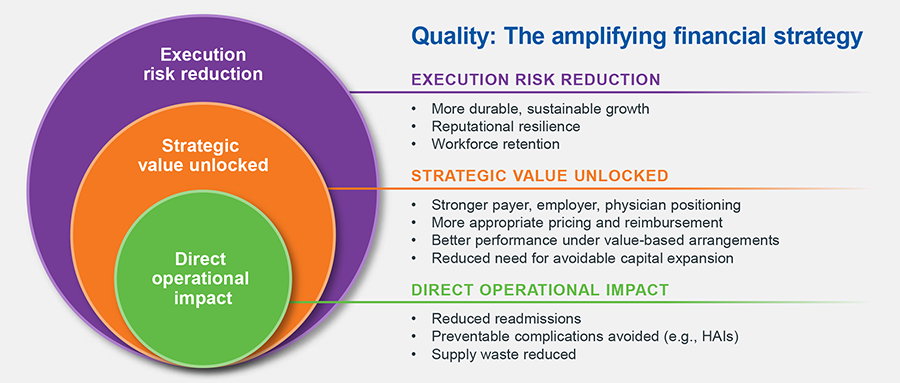
Quality—defined as the outcomes patients achieve and the reliability of the care they experience—shapes health system performance in several ways. Unwarranted variation in clinical practice and inconsistency in execution contribute to preventable complications, excess length of stay, readmissions, and avoidable utilization. Each of these carries a financial cost and constrain capacity. Together, they drag margins, throughput, productivity, and the ability to manage risk. But viewing the financial implications of quality with this lens only captures “first-order” implications.
Quality also shapes growth and capital strategy. Organizations that deliver care reliably create effective capacity through better throughput and fewer complications, reducing the need for capital expansion. Consistent outcomes also strengthen patient trust, referral patterns, and payer relationships. In this way, quality influences how organizations grow.
For health systems, quality is therefore an enterprise lever that affects cost structure, capacity, growth, reputation, and risk. Organizations that deliver reliable care operate with lower resource intensity and greater strategic flexibility.
Quality: the factor you can control
Quality is one of the few enterprise levers health systems can directly control. Healthcare organizations are buffeted by market and regulatory forces beyond their control, but they can influence how reliably they deliver care. That reliability has immediate operational consequences but extends beyond that. Organizations with consistent performance are positioned to succeed under value-based arrangements—a critical factor as Medicare increasingly ties reimbursement to those models. Organizations with higher quality increasingly become “must-have” health systems in payer networks while also strengthening trust with patients and referring physicians.
In this way, quality is not a separate workstream. It is a core organizational capability that influences cost structure, growth potential, and execution risk.
Why quality efforts stall—and what it takes to make them stick
Unfortunately, most organizations do not think of quality this way and are not set up to manage it accordingly. In many systems, quality remains organized as a function—a series of isolated improvement efforts that are tracked through dashboards, reviewed in committees, and reported publicly as necessary. While these efforts can produce meaningful gains, they rarely lead to consistently sustained improvement across the enterprise.
Most organizations today can identify performance issues with precision. The challenge is knowing what to do next. Quality data often functions as a lagging indicator, leaving organizations reactive rather than preventive, while accountability for improvement can become diffuse. The gap—or chasm, as the IOM termed it—between what organizations know and what they consistently do remains the central challenge.
Bridging that chasm requires a shift in how quality is positioned and managed. If quality is to function as a financial lever, it must be embedded in the way the organization operates. The shift begins with clear expectations for how care is delivered and how performance is defined, supported by standards that reduce unwarranted variation while allowing for appropriate clinical judgment. It extends to accountability by reinforcing that quality and safety are everyone’s responsibility, while assigning clear ownership of outcomes. It then carries into decision-making. Growth, service-line expansion, capital allocation, and capacity decisions should be informed by whether the organization can deliver care reliably at scale.
Quality dashboards should not sit apart from financial dashboards; they should be reviewed together as part of the same operating conversation. Viewed through a quality lens, cost, capacity, throughput, outcomes, safety, and experience are different dimensions of the same performance system, not separate discussions.
Organizations that take this approach focus on consistency—applying standards and addressing variation as it arises—rather than relying on discrete initiatives and interventions. Over time, that consistency enables strong performance to compound. Quality gains are sustained and financial performance improves as a byproduct of disciplined execution.
None of this happens without leadership demonstrating a willingness to confront variation, reinforce standards, and create a culture of consistency and accountability that supports high reliability over time.
Conclusion: The financial upside of quality
Health systems cannot control reimbursement policy, labor markets, or broader economic volatility. But they can control how reliably they deliver care. That reliability, or lack thereof, carries significant financial implications.
Consider the following questions:
- How much incremental market share are we projecting to capture in the next five to 10 years? To what extent does this incremental market share capture rely on being the highest quality option?
- How would consistently better outcomes and lower avoidable utilization affect reimbursement, the system’s reputation in the community, and payer relationships over time?
- If the average $2 billion health system spends roughly $100 million annually on capital, how much of that investment could be delayed or avoided through more efficient, quality-driven use of existing capacity?
Viewed through this lens, quality leads to strategic financial decisions. Organizations that recognize quality as a core business discipline will be better positioned to strengthen margins, support growth, and deploy capital more effectively over time.