

In today’s rapidly evolving healthcare environment, master planning can no longer be confined to architecture and facility initiatives alone. Traditional approaches often prioritize buildings, focusing on square footage, adjacency, and future-state campus design, often overlooking how facilities function within the broader healthcare ecosystem and how capital investments align across the system.
When financial strategies, market realities, and operational needs are not fully integrated into the planning process, the results are predictable. Health systems may become overbuilt, with low utilization, negative return on investment, and limited growth potential. In other cases, they remain underbuilt, unable to fully leverage existing assets, resulting in fragmented facilities that struggle to adapt and function cohesively.
An integrated master planning approach addresses these challenges by shifting the focus from individual projects to an interconnected system of care delivery, financial sustainability, and community impact. It aligns facility planning with strategic, operational, and capital priorities to support more effective decision-making.
Holistic planning begins not with floor plans, but with a clear understanding of the environment in which the health system operates, including organizational goals, demographics, workforce, and evolving care models. When developed this way, each decision serves a defined purpose within a broader framework.
The result is a master plan that functions not only as a development roadmap, but as a strategic tool that guides when, where, and how to invest.
Evolving beyond traditional master planning
Traditional master planning methods rely on precedent and underlying planning assumptions, both of which are essential to the process. Challenges arise when those assumptions are not fully grounded in data, market realities, and operational performance. In some cases, projections are driven by aspirational growth targets or facility-based assumptions rather than a clear understanding of demand, care delivery, and system capacity.
For example, capacity constraints are often addressed through new construction, such as adding inpatient beds, when operational improvements, such as length of stay optimization, patient flow redesign, or transfer efficiency, could significantly reduce or eliminate the need for additional capacity. Without this perspective, capital investments may not align with actual system needs.
Today’s healthcare environment requires a shift toward integrated strategies designed for execution (Figure 1). This approach emphasizes alignment across planning, operations, and financial performance while enabling organizations to adapt as conditions evolve.
Figure 1: Evolving from traditional to integrated master planning
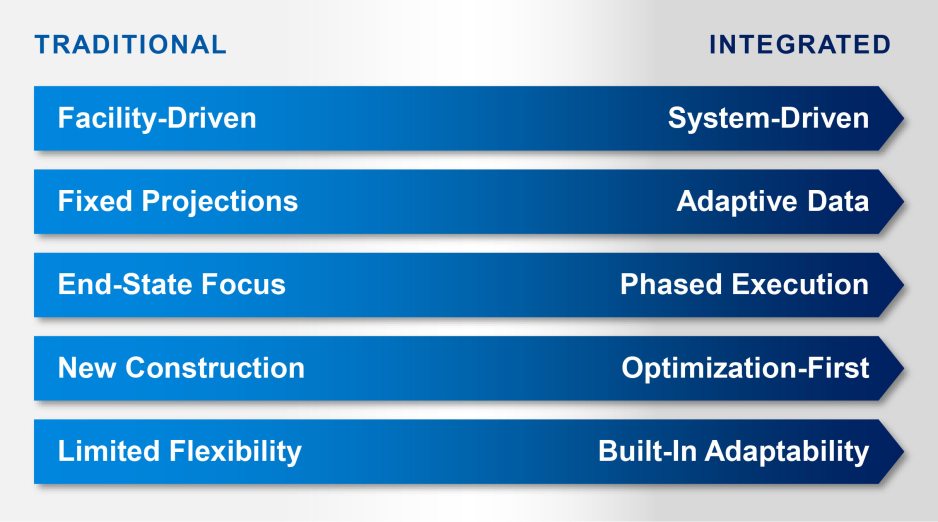
In practice, this redefines the role of the master plan. Rather than serving as a document built around long-range projections and a defined end-state vision, the plan becomes a framework that supports end-to-end decision-making. It is informed by real data, grounded in operational realities, and structured to guide phased implementation.
This approach requires alignment across disciplines. Facility planning, financial strategy, operational design, and market analysis must be developed in parallel. Lean-led design and operational workflow analysis tie planning decisions directly to performance outcomes across the care delivery model, not just physical space requirements.
An integrated approach aligns financial, operational, and strategic priorities within a single framework that can adapt as conditions evolve. Rather than relying on fixed projections, it supports ongoing decision-making and prioritization.
As a result, master plans become practical tools for guiding investment, evaluating trade-offs, and responding to change with clarity. The outcome is a plan that can be executed, adjusted, and sustained over time.
Case study: Integrated planning in action
A health system was preparing to construct a new medical office building based on projected growth and traditional forecasting models. However, a focused review of utilization, demand, and operations showed that projected growth could be addressed through targeted improvements to existing facilities. By reframing the problem, the organization avoided unnecessary capital investment and operational disruption, reinforcing confidence in a more integrated, data-driven approach.
That shift in perspective proved critical when the system faced a more complex decision. A conventional master plan recommended a new 120-bed inpatient tower with an estimated cost exceeding $200 million to address perceived capacity constraints. Leadership struggled to justify the investment due to limited return and regulatory challenges, including difficulties in demonstrating responsible reuse of existing inpatient space.
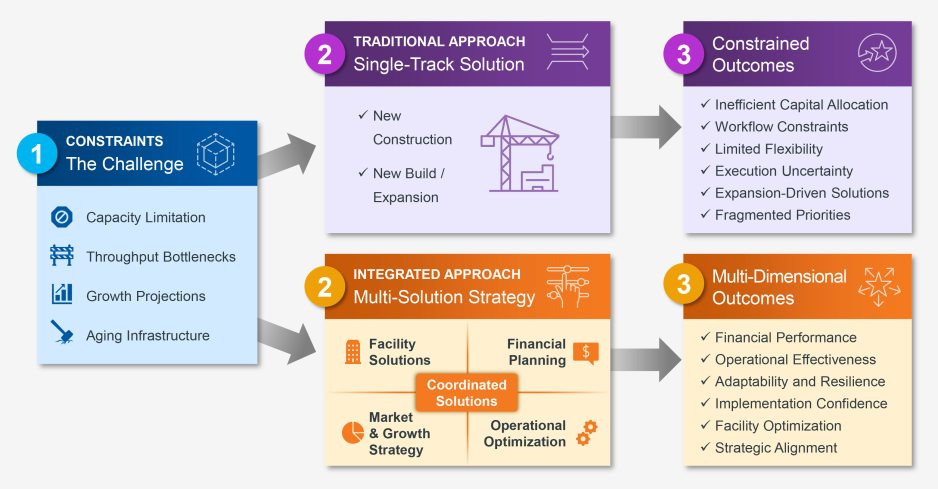
Rather than advancing another building-focused solution, leadership aligned around a broader, system-level perspective (Figure 2). The organization applied a comprehensive, campus-wide planning approach. The focus shifted from adding beds to optimizing the care delivery system through data-driven benchmarking, best practices, and structured decision-making aligned with Lean principles.
This approach engaged leadership in evaluating multiple scenarios, clarifying trade-offs, and aligning on implementation sequencing, resulting in shared ownership.
The resulting strategy redirected capital toward optimizing existing inpatient capacity, improving patient flow, and enhancing clinical efficiency. Surgical services were refined to support throughput and quality, while select programs were positioned for future growth. Existing facilities were reconfigured to improve access and patient experience.
Figure 2: Integrated planning in action
Closing thoughts: delivering value from integrated master planning
The most effective master plans are not defined by how far they project into the future, but by how well they can be executed and adapted over time. An integrated approach ensures that planning decisions remain aligned, actionable, and resilient as conditions evolve, delivering measurable value across six key dimensions:
- Strategic Alignment
Ensures facility investments directly support system priorities, growth strategies, and evolving care models. - Financial Performance
Improves return on investment by aligning capital decisions with demand, utilization, and operational efficiency while avoiding overbuilding or underinvestment. Aligning capital investment timelines with financial plans supports timely execution. - Operational Effectiveness
Integrates operational design and Lean-led principles to enhance patient flow, staff efficiency, and care delivery performance while identifying improvement opportunities early in the planning process. - Facility Optimization
Maximizes the value of existing assets through repositioning, reuse, and targeted upgrades rather than defaulting to new construction. - Adaptability and Resilience
Creates plans that evolve with regulatory changes, policy shifts, and market dynamics, ensuring long-term relevance. - Implementation Confidence
Provides leadership with a clear, actionable roadmap that supports decision-making, sequencing, and execution over time.