

The financial and operational impact of the One Big Beautiful Bill (OBBB) on hospitals and health systems has been well-documented since the bill’s July 2025 passage, a topic our Vizient colleagues recently explored in-depth.
And the same looming threats afflicting hospitals—including both a projected rise in the uninsured and bad debt from Medicaid payment changes in the OBBB and the possible end of the Affordable Care Act’s enhanced premium tax credits—are also keeping insurers up at night.
These difficult challenges are surfacing during a period when payer-provider relationships are already contentious and zero-sum in nature. Both sectors are facing headwinds: health plans have experienced increased earnings pressure following the relatively calmer waters they navigated during the pandemic, while hospital margins remain fragile even after a post-pandemic recovery.
Payer-provider relationships are further complicated by the increased use of AI tools in revenue cycle management, which has created an arms race around claims and approvals or denials. Many employers are also balking at rising costs and considering alternatives to traditional health plan coverage for their employees, including individual coverage Health Reimbursement Arrangements, or ICHRA plans.
As we work with healthcare organizations to navigate a tense environment and prepare for future threats, we are frequently running into a key existential question for our clients: Where will the money to sustain healthcare operations come from?
The current outlook for payer-provider relationships…
In our observation, payer-provider relationships can generally be categorized into one of three categories: contentious “hard resets” strategies, traditional zero-sum negotiations, and radical collaboration (Figure 1).
Figure 1. Approaching the payer-provider relationship holistically
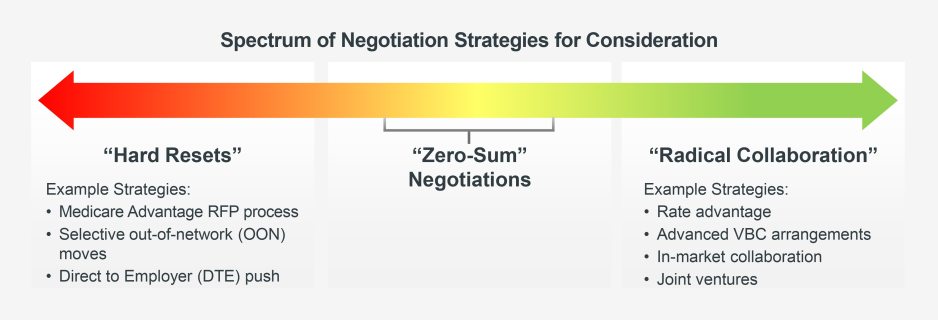
At the moment, hard resets are predominating in payer-provider relationships, which may feel like a natural extension of the adversarial rate negotiations in traditional zero-sum relationships. Hard resets are often marked by protracted, down-to-the wire contract negotiations—and in some cases, contract terminations or out-of-network standoffs.
We are also observing more fluidity in the nature of payer-provider relationships. Today, many organizations revisit their strategic approach to these relationships every 6-12 months, instead of recalibrating every 3-5 years during contract negotiations. This increased fluidity is also occurring hand in hand with more hard resets—which risks destabilizing local market dynamics even further.
…And the case for radical collaboration
But there is a better path forward. While hard resets are not going away, we believe radical collaboration is an emerging solution for many markets. These relationships can include advanced value-based care models, collaboration within markets, and even joint ventures.
The potential rise in the uninsured population due to the factors explored above will create shared pain for payers and providers alike. Patients covered by Medicare Advantage and Medicaid comprise a significant proportion of health system users, but both programs reimburse less than the cost of care, creating an unfavorable economic situation and a burning platform for payer-provider strategies that enable both growth and margin.
Further, moves by some national plans to selectively exit geographic markets and products deemed to be economically unfavorable create an opportunity for locally based payers and providers that are dependent on growth for their future viability. We believe these organizations—whose destiny is tied to the local markets they serve, and do not have the option of “shrinking to success”—will be increasingly motivated to collaborate. From the provider standpoint, this dynamic is revealing which payers are truly committed to their market and which organizations are willing to exit when the economics turn unfavorable. Regional health system leaders should use this moment of truth to inform their future collaborations with payers.
Payers and providers that commit to radical collaboration will need to work through multiple facets of their partnership structure, including governance models and incentive sharing. Building trust and transparency is critically important: in some collaboration models, payers and providers will need to share information far more openly than they are accustomed to. These efforts will require greater trust between parties, appropriate tools and safeguards, and a greater sense of imagination and creativity to identify and develop a future shared operating and business model.
In the best-case scenario, payers and providers will build a new relationship framework out of this dialogue.
Closing thoughts
No matter how contentious their interactions are, payers and providers ultimately need each other to sustain operations and care for patients in the markets they serve.
To be sure, many national, large-scale healthcare companies can temporarily prioritize margins over growth in response to unfavorable economic conditions, and might, as previously discussed, consider exiting markets or pursuing non-renewals across certain business lines.
However, the majority of health systems and their health plan counterparts must prioritize both growth and margins.
Achieving these ends simultaneously is difficult and requires intensely focused discipline, planning, and partnership. In our view, future success will require payers and providers alike to think bigger and broader and act collectively with agency and velocity.
Ultimately, embracing radical collaboration is the only way to solve these difficult, shared problems.
Together, payers and providers can build a path to growth and margins—and answer the question of where the money will come from to care for the communities they serve.