

Healthcare systems spend enormous energy designing the visible parts of care—clinical programs, digital tools, new facilities, strategic partnerships. But the most important structure in healthcare is largely invisible.
Trust.
It exists between clinicians and patients, within leadership teams and boards, across care settings and specialties, and even between providers and the external partners who support care delivery. When trust is strong, organizations can move quickly, make difficult decisions, and adapt to change. When it’s weak, progress slows—and even well-designed strategies struggle to take hold.
Healthcare has long faced challenges maintaining that infrastructure. Fragmented care delivery, rapid technological change, and increasing operational complexity have made trust harder to sustain. Patients question whether their care is truly coordinated. Clinicians weigh the implications of new technologies on safety and autonomy. Leaders must navigate high-stakes decisions where alignment is not guaranteed.
In moments of transformation—whether integrating organizations after a merger, introducing artificial intelligence, or redesigning care delivery—the integrity of that invisible architecture becomes even more important. Trust grows when people feel represented, when objectives are clear, and when decision-making is transparent.
In many ways, trust determines the pace at which healthcare organizations can move.
The expert perspectives that follow examine how trust is built, strengthened and sustained across the healthcare ecosystem.
Closing the trust gap in fragmented care delivery
Erika K. Johnson, Vice President of Strategic Research, Vizient Research Institute
Why it matters: Emergency department overcrowding is often framed as a capacity problem. But for patients with multiple chronic conditions, ED use is frequently a symptom of something deeper: fragmented access and disconnected care. When patients cannot secure timely appointments or experience coordination across multiple providers, they are forced to navigate the system alone. Over time, those gaps erode trust, and fragmentation accelerates.
Erika K. Johnson, vice president of strategic research and leader of the Vizient Research Institute, says health systems cannot meaningfully reduce avoidable ED utilization without addressing the trust gap facing their most clinically complex patients.
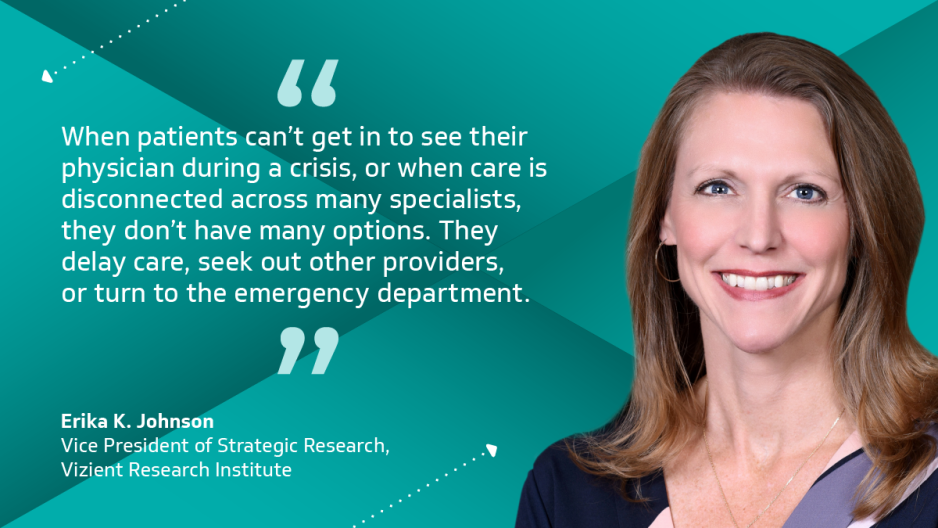
“Patients with multiple chronic conditions are interacting with our health system more than anyone else,” Johnson said. “When they can’t get in to see their physician during a crisis, or when care is disconnected across many specialists, they don’t have many options. They delay care, seek out other providers, or turn to the emergency department.”
The Vizient Research Institute’s recent study, The Access Imperative: Reimagining care delivery for a more complex patient population, found that patients with multiple chronic conditions drive a disproportionate share of utilization across the system, accounting for nearly 80% of inpatient admissions and most outpatient visits. Yet more than half report frustration with appointment access, leading them to often delay care, switch providers, or episodically use the ED.
When trust erodes, utilization patterns shift. Nearly one in five patients with multiple chronic conditions say they prefer to seek follow-up care in the ED or urgent care rather than wait for an appointment with their physician. For health systems, that preference compounds overcrowding and increases cost. For patients, it reflects uncertainty about whether anyone is truly coordinating their long-term care.
Reducing avoidable ED use, Johnson argues, requires rebuilding trust through structural redesign.
Strategies to consider:
- Create protected access for high-complexity patients. Dedicated access capacity for high-risk chronic patients—including rapid-response slots and direct care team escalation pathways—reduces fragmentation by reconnecting patients to their longitudinal care team when it matters most.
- Integrate specialties around the patient. More than 60% of Medicare-age patients with multiple chronic conditions see five or more specialists. Multi-specialty care models that align appointments, share care plans, and communicate proactively reduce fragmentation—and the perception that patients must coordinate their own care.
- Strengthen continuity within one system. Annual Medicare spending for chronically ill patients treated across more than one health system is roughly 30% higher than for those treated within a single system. Nearly 80% of these patients say they prefer to receive care within one system. Tightening referral management, closing leakage gaps, and reinforcing system-wide accountability protect both trust and margin.
- Address trust barriers explicitly. Patients with multiple chronic conditions are more likely to report that providers do not listen or fail to consider long-term health needs. Education, longer visit times, and intentional communication training help patients feel seen beyond the immediate episode.
- Expand care-at-home and on-demand options. Most patients with multiple chronic conditions report that home-based services are important to them. In-home visits, urgent in-home evaluation, and transitional care programs reduce transportation barriers and provide alternatives to ED use when symptoms escalate.
“As the chronically ill population grows and clinical complexity accelerates, ED overcrowding will not be solved solely by adding beds or staffing shifts,” Johnson said. “Health systems that redesign care around access, coordination, and continuity for multi-chronic patients will not only reduce avoidable utilization—they will rebuild the confidence that keeps patients anchored within one system and ultimately improve outcomes and cost.”
Explore key insights from the Vizient Research Institute study about how chronic disease is reshaping healthcare economics, access, and loyalty.
Turning uncertainty into alignment through trust
Sarah Wiley, Managing Director, Strategy and Business Transformation
Why it matters: How employees show up at work is deeply influenced by how they feel about their role—how they are treated and whether they feel part of something larger than themselves. When people don’t feel heard, seen, or recognized—or when they don’t understand what’s happening around them—they are less likely to bring their full effort and engagement.
This is particularly true during integrations, which can raise questions about job security, role changes, workflows, and organizational identity. If left unaddressed, that uncertainty can quickly erode engagement, collaboration, and institutional momentum.
Trust is the foundation of successful integrations. A sense of shared purpose, direction, and vision helps people navigate change and feel connected to the future organization they are becoming part of.
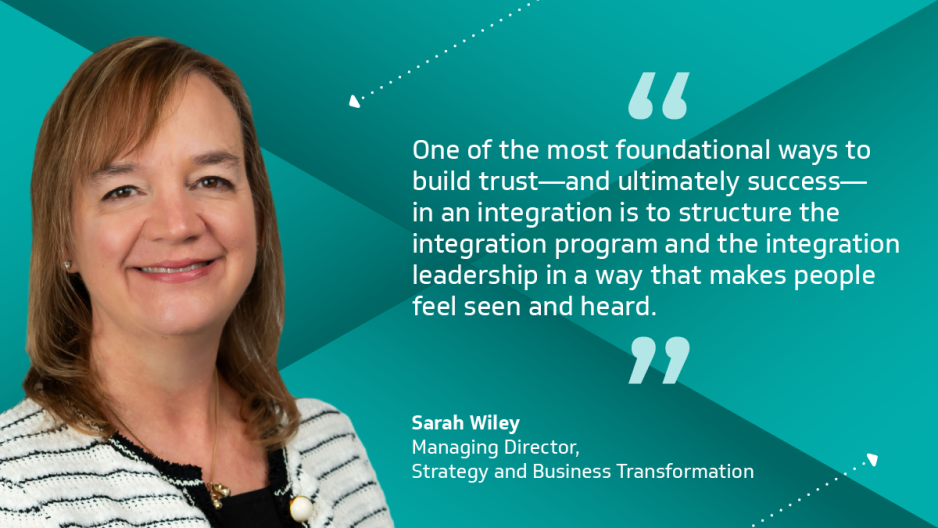
“One of the most foundational ways to build trust—and ultimately success—in an integration is to structure the integration program and integrate leadership in a way that makes people feel seen and heard,” said Sarah Wiley, managing director, Strategy and Business Transformation.
“The easiest way to do that is to think about the leadership of your integration as a combination of leaders from both (or multiple) organizations you’re bringing together. That gives people from each organization a sense that their perspective is represented, shared, and heard—that there is a voice representing them in decisions being made.”
Strategies to consider:
- Build in representation. Whenever possible, maintain and preserve the strengths of each organization and design the integration process to reflect that respect and desire to preserve the best of both. Include leaders from each organization in integration leadership to create a sense of voice, visibility, and shared decision-making. Representation helps organizations understand values, concerns, and sensitivities and enables leaders to address them proactively.
- Communicate with transparency. Be open where you can, communicating as much as possible to build trust in a shared purpose and vision.
- Clarify objectives and values. Clarity in purpose nurtures a strong sense of shared direction, value, and vision. Be crystal clear about objectives and what you’re trying to accomplish and be as values-driven as you can. Clear goals and values help people engage, buy in, and accept difficult decisions even when those decisions run contrary to individual preferences.
Read Sarah Wiley’s article, At the pace of trust — integration at every stage discussing trust as a prerequisite for integration and a byproduct of doing it well, forming the foundation for bringing people together.
Build trust as a leadership discipline
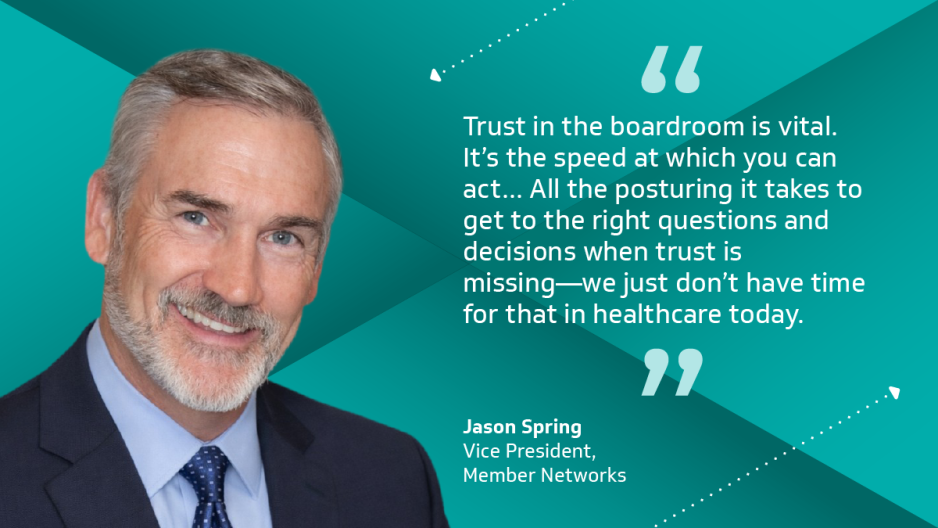
Jason Spring, Vice President, Vizient Member Networks
Why it matters: For healthcare boards and executive leaders, trust is often described as a cultural value—something to aspire to, protect or reference in moments of strain. Jason Spring, vice president, Vizient Member Networks, argues that framing is no longer sufficient. In today’s operating environment, trust functions as a leadership discipline that directly affects decision speed, governance effectiveness, and an organization’s ability to respond under pressure.
“Trust in the boardroom is vital,” Spring said. “It’s the speed at which you can act when you have trust in the room versus when you don’t. All the posturing it takes to get to the right questions and decisions when trust is missing—we just don’t have time for that in healthcare today.”
Drawing on decades of experience working with and serving on boards, as well as his role leading the Vizient Governance Academy, Spring outlined several ways boards and executive teams can intentionally build—and sustain—trust as a core organizational capability.
Taken together, these practices move trust from a vague cultural aspiration to an operational asset. In an environment defined by continuous disruption, trust is an essential infrastructure: enabling boards and leaders to act with speed, clarity, and confidence.
Strategies to consider:
- Build credibility through consistent action over time. Trust is built through repetition, not messaging. Leaders who behave predictably, especially during difficult moments, create stability. Inconsistency forces organizations to reset trust repeatedly, slowing progress and weakening confidence.
- Close the gap between integrity and perception. Many leaders believe they are acting with integrity but underestimate how prior experiences, leadership turnover, and informal communication shape trust. Transparency alone is not enough. Leaders must communicate with context, acknowledge uncertainty, and recognize how history influences how messages are received.
- Design boards and committees for trust, not just expertise. Effective governance depends on more than assembling the right resumes. Board composition should balance technical expertise with the ability to work collaboratively and respect healthcare’s unique context. Committees play a critical role in this design, but boards must trust committees to do meaningful work between meetings and resist the urge to relitigate decisions at the full board level. “When committees are empowered and trusted, governance stays agile,” he said. “When their work is routinely revisited or second-guessed, boards slow themselves down and signal internal mistrust.”
- Normalize the sharing of bad news. Trust strengthens when boards expect (and receive) a full picture of organizational performance. If governance conversations are dominated by positive updates, leaders should assume important risks are being missed. Boards that respond to bad news with inquiry rather than blame encourage earlier disclosure and better decision-making. “If you’re only getting good news quarter after quarter, something’s wrong,” Spring said. “Trust comes from knowing you’re getting the full story.”
- Reinforce accountability, even when it hurts. Boards play a defining role in sustaining trust by backing leadership accountability. When high performers are allowed to bypass standards or values, credibility erodes quickly across the organization. Consistency—even at financial or operational cost—signals that trust and fairness are not negotiable.
Listen to this HealthLeaders podcast where Spring discusses what differentiates high-performing boards and why governance, culture, trust, and competency development matter more than ever.

Establish trust early to scale AI responsibly
Andrew Rebhan, Senior Director, Intelligence
Why it matters: When it comes to artificial intelligence, adoption and trust are not the same thing. Given how quickly the technology is evolving, stakeholders feel increased pressure to use AI across several business functions to not fall behind. However, speedy adoption can often come at the expense of responsible planning and design.
“Trust is difficult to assess because it isn’t one uniform concept,” said Andrew Rebhan, senior director, intelligence. “It can vary depending on the context: a CIO will have different measures of trust than a CEO; a patient’s trust in AI will vary if we’re talking drafting portal notes versus guiding surgery; and if clinicians feel AI is being imposed on them, resistance grows.”
That means health system leaders must strategically approach AI not only as a technology, but as a trust driver. Transparency, validation, and governance matter as much as functionality.
It’s tempting to scale quickly, which is why Rebhan recommends being deliberate.
“If you start with clear pain points and demonstrate focused value, that helps build confidence for future applications,” he advises.
Strategies to consider:
- Get your governance in order ASAP. From early exploration to post-deployment monitoring, AI will require a rigorous and continual focus on governance. This can include having clear accountability assignments, defined budgets and timelines, established KPIs, and structured tool validation processes. This approach to oversight will be a foundational base for building trust as AI programs start to scale.
- Engage frontline staff early. Your workforce’s AI skepticism can stem from several factors, including concerns around patient safety or job security. To combat this, give frontline users a seat at the table to help define and mold the organization’s AI roadmap. Include clinicians and operational leaders in identifying the pain points AI is meant to address and pilot solutions with trusted champions who can help build momentum around AI adoption. Also key: communicate clearly whether AI is intended to reduce administrative burden, redesign workflows or augment staffing models.
- Be transparent with patients about when and how AI is used. “There’s no excuse for actively hiding AI use from patients, so proactively disclose its use whenever possible, particularly in higher-sensitivity workflows or in patient-facing interactions,” Rebhan said. Transparency does not always require technical detail, but it does require clarity and choice. Offer opt-out pathways when appropriate.
- Segment communication by stakeholder and use case. Patients may accept AI for scheduling but hesitate when it influences diagnosis. Younger clinicians may adopt tools more readily than late-career peers. Some patient populations rely heavily on physician endorsement before accepting AI-supported care. Tailor messaging and engagement strategies accordingly rather than relying on a single enterprise-wide narrative about AI adoption.
- Put more pressure on AI vendors. “Hype cycles can be a breeding ground for mistrust because suddenly every company wants to be an AI company,” Rebhan said. This means that healthcare adopters need a thoughtful approach to filter through the vendor marketplace and find solutions that back up marketing claims. This also means not being shy about challenging the biggest tech platforms that are leading AI development. “Companies like OpenAI, Google, and other Big Tech companies hold an immense amount of power right now, and their approach to AI is all gas, no brakes. The leaders of these companies are in a race to AI superintelligence, and they have no idea what is on the other side—it could be a new era of prosperity, or it could be utter chaos,” he said. Hospital and health system leaders must hold vendors accountable to demonstrate that their AI development approach is safe and ethical by design.
AI will continue to expand across care delivery, and the approach to establishing and maintaining trust in the technology is a never-ending process. Whether AI strengthens or strains institutional credibility will depend on how thoughtfully leaders introduce it.
Read Rebhan’s recent article about the rise of the AI care broker to discover how AI-mediated care could redefine patient access and trust.
Strategic spend starts with trust
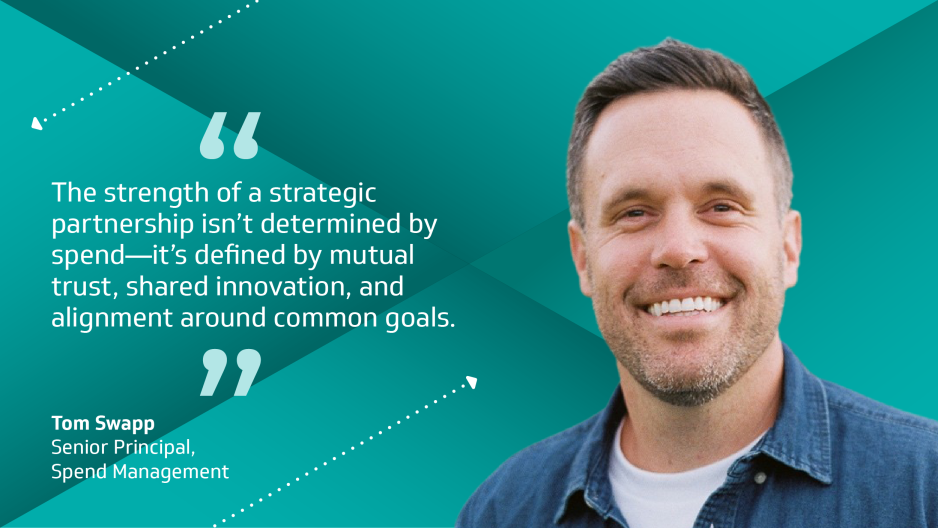
Tom Swapp, Vizient Senior Principal
Why it matters: When providers and suppliers move beyond purely transactional interactions and build trust-based, strategic relationships, it strengthens care delivery, aligns priorities across the health system, and supports long-term financial sustainability. Purposeful engagement with suppliers helps health systems better manage spend, improve quality of care, and foster collaborative innovation—which matters deeply in today’s challenging financial environment.
“The strength of a strategic partnership isn’t determined by spend. It’s defined by mutual trust, shared innovation, and alignment around common goals,” said Tom Swapp, Vizient senior principal. “The more progressive health systems we see are those who are embracing their suppliers as an extension of their category management team.”
Strategies to consider:
- Move beyond transactional relationships. Traditional supplier relationships often focus on volume and cost alone, which can inadvertently make engagements about purchase orders instead of partnership. Trust is strengthened when providers and suppliers both invest in shared outcomes—not just the next transaction.
- Conduct intentional planning and due diligence. Before partnering, healthcare supply chain teams should thoroughly understand the supplier’s culture, competencies, and alignment with organizational goals. Joint planning builds transparency and sets expectations that help both sides succeed together.
- Emphasize mutual transparency and communication. Open, ongoing dialogue about needs, challenges, and priorities—not just contracts and prices—is foundational to trust. Regular communication ensures suppliers understand provider pain points, and providers understand supplier constraints, which builds credibility and reduces surprises down the line. “If both the health system and the supplier can be more transparent about what their organizational goals and objectives are, it helps create a better negotiating environment,” Swapp said.
- Start with a focused set of strategic partners. Rather than spreading resources thin across thousands of vendors, prioritize a core group of suppliers—both locally and nationally—who are committed to deeper engagement. These partners can serve as trusted allies in quality improvement, operational alignment, and cost management.
- Align goals to unlock shared value. When providers and suppliers co-design goals—such as improved patient outcomes, operational efficiencies, or innovation milestones—both sides feel invested in the success. This mutual alignment turns suppliers into strategic partners who can proactively help address the challenges health systems face. “When health systems and suppliers treat each other as equals, it sets up both for success and ultimately leads to improved outcomes,” Swapp said.
Read more about how purposeful supplier engagement improves relationships and furthers financial sustainability.